
If you work for yourself in the trades, the Indiana workers’ comp exemption proves you are not required to carry coverage on yourself. If you hire help, it is paperwork you must collect, because without it you can end up paying for someone else’s injured worker. This guide covers both sides: getting the exemption, and what to check before a sub starts work.
Key Takeaways
- The Indiana workers’ comp exemption certificate costs $20 total and is valid for one year, renewed annually.
- A certificate is not valid until the Worker’s Compensation Board stamps it, and becomes effective at midnight seven business days after that file stamp.
- An exemption never covers your employees. If your business has workers, you must still carry workers’ comp for them.
- Anyone hiring a contractor or sub should collect proof before work starts: a stamped certificate of exemption holds the hiring party and its insurer harmless (Indiana Code 22-3-2-14.5), and hiring a sub without a Board certificate showing the sub complied with the comp law can leave you liable to the same extent as the sub for injuries to the sub’s employees (Indiana Code 22-3-2-14).
What Is the Indiana Workers’ Comp Certificate of Exemption?
Indiana’s workers’ compensation certificate of exemption is a one-year document that proves a qualifying self-employed worker is not required to carry workers’ comp on themselves. The Department of Revenue calls it a clearance certificate. It is a certificate of exemption, and it only counts once the Worker’s Compensation Board stamps it.
The state issues it, not an agent or a carrier: the Department of Revenue issues the clearance, and the Board stamps it before it takes effect. New to workers’ comp? Our workers’ compensation for your business overview covers the basics.
Who Can Get an Indiana Workers’ Comp Exemption?
Four types of filers can apply, all sharing one trait: you work for yourself and are not someone else’s employee. The eligible categories are:
- Independent contractors who meet the IRS test
- Sole proprietors
- Partners in a partnership
- Members or managers of an LLC
Under Indiana Code 22-3-6-1(b)(7), you count as an independent contractor if you qualify under IRS guidelines. The Department of Revenue also checks that your Indiana returns are filed and any balance is paid before it clears you.
Classification is not always obvious. If you are unsure whether someone is a contractor or an employee, ask your agent, or an attorney or accountant for a close call.
How to Apply, What It Costs, and How Long It Takes
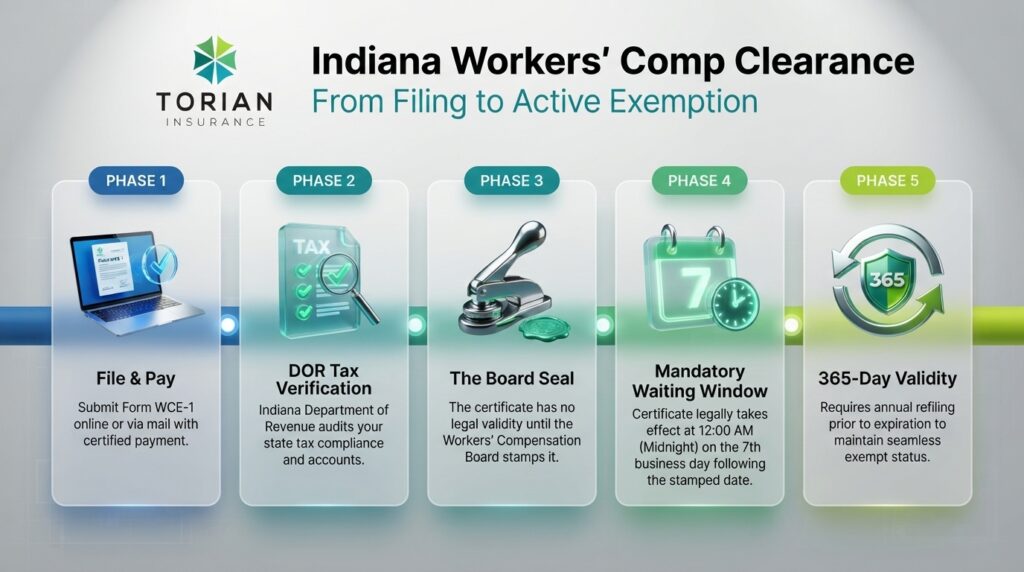
You apply through the Indiana Department of Revenue, pay $20 total ($5 to the DOR and $15 to the Worker’s Compensation Board), and wait for the Board to stamp the certificate.
Applying online through the Department of Revenue is quickest, and the certificate is emailed; you can also mail the paper Form WCE-1 with a money order or certified check. Some solo contractors carry a policy on themselves instead of filing; ask your agent which fits.
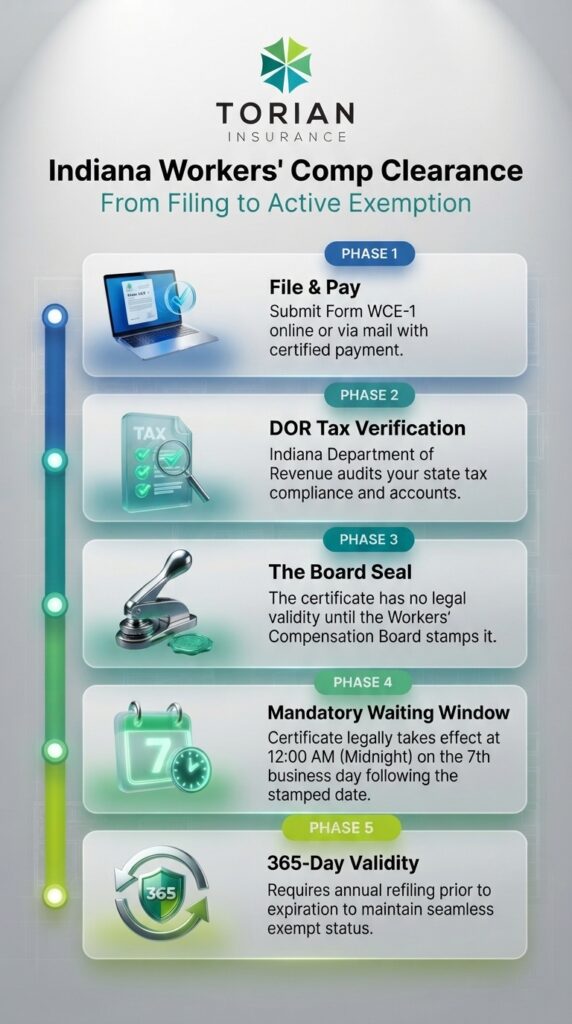
Here is the timeline, start to finish:
- Apply online, or mail the paper WCE-1 with your payment.
- The Department of Revenue verifies your tax filings. Allow two to three weeks for this step.
- The Board stamps the certificate. It is not valid until stamped.
- The certificate takes effect at midnight seven business days after the file stamp.
- It expires one year from issue, so re-apply annually to stay exempt.
Does an Indiana Workers’ Comp Exemption Cover My Employees?
No. An Indiana workers’ comp exemption applies only to you, the filer. It never extends to anyone you employ. The application form says it plainly: even if you are exempt, you must cover any employees of your business.
This catches small operators off guard. You can be a legitimately exempt sole proprietor and still owe workers’ comp the moment you hire your first helper. Once you are hiring, our workers’ compensation page explains employee coverage.
Hiring a Sub? What to Collect Before They Start
Before a subcontractor sets foot on your job, collect proof of their workers’ comp status: either a current, Board-stamped certificate of exemption, or a workers’ comp certificate of insurance if they have employees. Torian Insurance, an independent agency in Evansville, can review the insurance language in your subcontracts so you know what to require.
What you collect depends on the sub’s situation. Use this pre-job checklist:
| If the sub… | What to collect | Why |
|---|---|---|
| Has employees | A workers’ comp certificate of insurance showing current coverage | An exemption never covers the sub’s employees; without proof, you can be liable for them |
| Works alone (independent contractor, sole proprietor, partner, or LLC member with no employees) | A copy of their current, Board-stamped certificate of exemption | The stamped certificate holds you and your carrier harmless |
| Has a certificate that isn’t stamped yet, or was stamped fewer than seven business days ago | Wait, or require coverage until it is effective | Not valid until stamped; effective at midnight seven business days after the file stamp |
| Has a certificate more than a year old | A renewed certificate | Valid one year; must re-apply annually |
| Provides neither | Don’t start work until one is in hand | If the sub has employees, you may be liable to the same extent as the sub for their injuries (IC 22-3-2-14). |
| (You are a homeowner hiring work on your own home) | Not required under this section | Owner-occupied residential work is excluded from IC 22-3-2-14 |
Based on Indiana Code 22-3-2-14 and 22-3-2-14.5. Your contract may require other coverage, such as general liability, regardless of workers’ comp status.
When a sub hands you a stamped certificate of exemption, Indiana Code 22-3-2-14.5 does two things: it holds you and your insurer harmless, and it requires your workers’ comp carrier to accept the certificate like a certificate of insurance.
The stamp and the timing are what make the certificate count. For the wider set of documents Indiana businesses must produce, see our Indiana small business insurance requirements guide.
What If You Skip It? Liability Under IC 22-3-2-14
Skip the proof and Indiana law can put you on the hook for the worker’s injuries. Under Indiana Code 22-3-2-14, a contractor who sublets work to a sub without a Worker’s Compensation Board certificate showing the sub complied with the comp law is liable to the same extent as that sub for an injured employee.
The same statute reaches a business hiring a contractor: contract for work valued at more than $1,000 with a contractor who has not shown that certificate of compliance, and you can be liable to the same extent as the contractor. One exception: an owner contracting for work on their own owner-occupied home is excluded from this section.
Indiana also treats misrepresentation seriously: a contractor who knowingly or intentionally causes or assists employees to file a false statement of independent contractor status commits a Level 6 felony under Indiana Code 6-3-7-5(m). Stating everyone’s status accurately and collecting the paperwork avoids it.

How Torian Insurance Helps
Torian Insurance has served Evansville and the tri-state area as an independent agency since 1923, with a team that brings more than 1,000 years of combined experience. Because we work for you, not a single carrier, we can place contractor insurance and the right workers’ comp coverage for your trade.
For contractors who hire subs, the value is in the paperwork. We review the insurance language in your contracts and subcontracts so you know what to require before you sign, and we issue certificates of insurance for our own clients when a contract calls for one. We do not issue the exemption certificate; the state does.
Frequently Asked Questions About the Indiana Workers’ Comp Exemption
How much does the Indiana workers’ comp exemption cost, and how long is it good for?
It costs $20 total: $5 to the Department of Revenue (non-refundable) and $15 to the Worker’s Compensation Board. It is good for one year from issue, and you re-apply each year to stay exempt.
Do I need to collect a certificate of exemption from a subcontractor?
If you want the legal protection, yes. When a sub gives you a current, Board-stamped certificate, Indiana Code 22-3-2-14.5 holds you and your insurer harmless and makes your carrier accept it like a certificate of insurance. If the sub has employees, collect a workers’ comp certificate of insurance instead, since an exemption never covers a sub’s workers.
Can I require an exempt subcontractor to carry workers’ comp anyway?
Not once they have given you a valid stamped certificate of exemption. Indiana Code 22-3-2-14.5 says a hiring party may not require workers’ comp from someone who provided one. You can still require other coverage, such as general liability, through your contract.
How do I get a copy of my workers’ comp exemption certificate in Indiana?
The quickest path is to apply or re-apply through the Department of Revenue’s online system, which emails the certificate once the Board issues it. For questions about an existing certificate, contact the Department of Revenue at 317-232-5977.

Get the Paperwork Right Before the Job Starts
An Indiana workers’ comp exemption is simple to get and easy to mishandle. File for yourself if you qualify, keep it renewed, and never assume it covers a crew. If you hire, collect the stamped certificate or a certificate of insurance first. Not sure what to collect, or whether your coverage is right? Contact Torian Insurance to talk with a local agent.