

You signed a new commercial lease, and the property manager asked for a “COI” before move-in. Or you’re a general contractor onboarding a sub, and the paperwork just landed in your inbox. So what is a certificate of insurance, and what does it actually prove? The document is widely misunderstood on both sides of every contract.
Key Takeaways
- A certificate of insurance (COI) is a one-page document that summarizes an active insurance policy. It is informational evidence, not the policy itself.
- The US industry-standard COI form is the ACORD 25, titled “Certificate of Liability Insurance.”
- A COI reflects coverage at the moment it was issued and does not guarantee coverage will be in force when a future claim is made.
- A COI cannot modify the underlying policy. Listing a third party as “additional insured” does not by itself grant that status; the policy must be endorsed.
- Indiana does not have a state-mandated COI form. Requirements are governed by private contracts.
- Before accepting a COI, verify the named insured, coverages, limits, certificate holder, and required endorsements match what your contract requires.
What Is a Certificate of Insurance?
A certificate of insurance is a one-page document that summarizes the key terms of an active insurance policy. It is issued by the insurance company or licensed agent on behalf of the policyholder, and it gives a third party (a landlord, general contractor, lender, or venue) quick proof that coverage exists, what the limits are, and when the policy expires.
The standard US version is the ACORD 25 Certificate of Liability Insurance, published by the Association for Cooperative Operations Research and Development. Most COIs you’ll see in Indiana follow this format. The COI is typically free for the requestor and is issued by the insurer or agent, not the policyholder.
What a Certificate of Insurance Doesn’t Prove
A COI is informational, not contractual. It cannot modify the underlying policy, it doesn’t guarantee coverage will be in force when a claim is filed, and it does not by itself grant additional insured status. Treat it as a summary of coverage at one point in time, not a binding promise.
A COI is “a snapshot in time, nothing more,” as longtime insurance educator Bill Wilson puts it. Coverage can lapse, be cancelled, or be exhausted by other claims after the certificate is issued.
Three things a COI cannot do, in plain terms:
- It cannot change the policy. IRMI defines a COI as evidence of coverage; if the certificate conflicts with the policy, the policy controls.
- It cannot grant additional insured status on its own. The underlying policy must carry a separate additional insured endorsement.
- It cannot guarantee future coverage. The certificate does not auto-update if the policy is cancelled, non-renewed, or exhausted.
What’s on a Certificate of Insurance
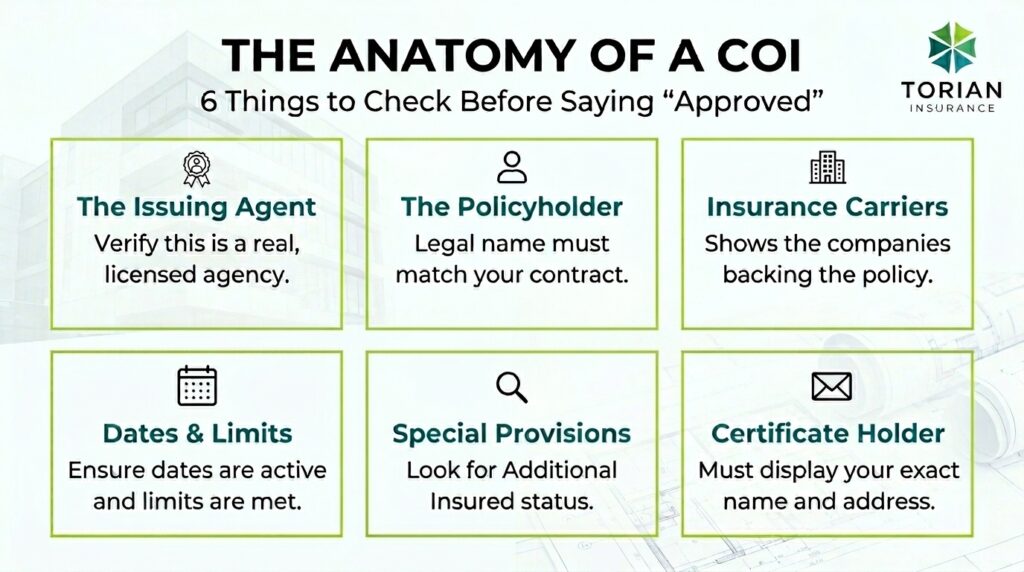
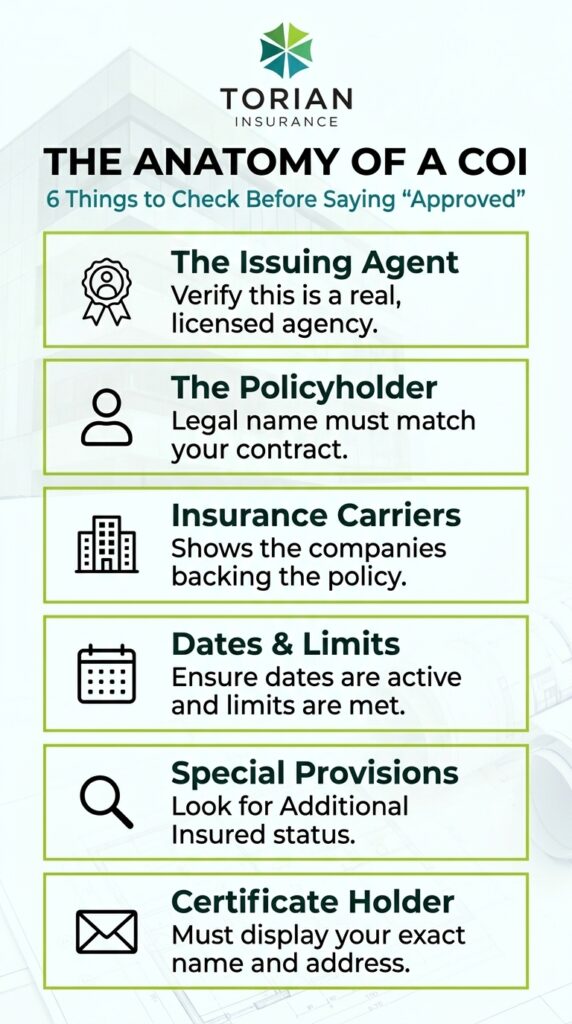
An ACORD 25 certificate has six main sections. Working from the top down:
- Producer: The agency that issued the certificate, with contact information.
- Insured: The legal name of the policyholder.
- Insurers: The carriers underwriting each line of coverage. A single COI may show multiple insurers when policies are placed across carriers.
- Coverages and limits: A grid showing each coverage type, policy number, effective and expiration dates, and limits. Most contracts focus on the general liability line because it is the most-verified coverage on the form.
- Certificate holder: The third party requesting and receiving the certificate.
- Description of operations: Free-text section where additional insured, waiver of subrogation, and primary and noncontributory wording appear.
Certificate of Insurance vs. Additional Insured Endorsement
A certificate of insurance shows that a third party has been named on a policy. An additional insured endorsement is what actually adds them to it. The two are easy to confuse, but listing someone on the certificate doesn’t grant coverage; only the endorsement on the underlying policy does.
The practical difference, in plain terms:
- Certificate of insurance: Informational. Free to the requestor. Does not modify the policy. Issued by the agent.
- Additional insured endorsement: Contractual. May carry a fee on the underlying policy. Modifies the policy. Must be added by the carrier before the certificate is issued.
When Indiana Contractors Need to Provide a Certificate of Insurance
Indiana contractors are commonly asked for a COI before starting any contracted work. Most general contractors will not let a sub start work until the COI is on file with limits matching the contract.
The most common scenarios in Indiana:
- Subcontractor onboarding by a general contractor.
- Bidding on public projects (city, county, or state work).
- Vendor approval at venues, institutions, or campuses.
- Lender requirements on commercial financing or property work.
For an overview of the policies that typically appear on a contractor’s COI, see Torian’s contractor insurance page.

When Indiana Landlords and Property Owners Should Request a Certificate of Insurance
Indiana landlords, property managers, and homeowners hiring contractors should request a COI any time another party is performing work on their property or operating from their building. The certificate confirms active coverage, names the landlord as certificate holder, and (with the right endorsement) extends additional insured status so the contractor’s liability policy can respond if the landlord is named in a related claim.
Common scenarios where a landlord or property owner should request a COI:
- Tenant move-in, especially for commercial leases.
- Contractor work on the property (roofing, HVAC, electrical, landscaping).
- Vendor service agreements at the building.
- Short-term rental management arrangements.
Requiring a COI is one piece of a landlord’s risk management; the right landlord insurance policy is the other.
How to Verify a Certificate of Insurance Before You Accept It
Verifying a COI is a five-minute task that prevents most coverage disputes. Most contract problems trace back to a certificate that wasn’t read carefully when it arrived.
Run through this checklist when a COI lands in your inbox:
- The named insured matches the party signing your contract.
- The coverage types listed are the ones your contract requires (general liability, auto, umbrella, workers’ compensation as applicable).
- The limits meet or exceed your contract minimums.
- The policy effective and expiration dates are current at the time of work.
- Your name appears as certificate holder, with the correct legal name and address.
- Required endorsement language (additional insured, waiver of subrogation, primary and noncontributory) appears in the description of operations.
- The agency that issued the certificate is a real, licensed agency. A quick web check confirms this.
Indiana Context: What State Law Requires (and Doesn’t)
Indiana does not have a state-mandated COI form, statute, or template. Certificate of insurance requirements in Indiana are governed by the underlying private contract, not by state insurance regulations. Some Indiana contracts also require an insurance bond alongside a COI; the two are different instruments and one does not substitute for the other.
For a broader look at the coverages Indiana businesses are typically asked to carry, see our guide to Indiana small business insurance requirements.
How Torian Insurance Helps with Certificates of Insurance
Torian Insurance is an independent agency, which means we shop multiple carriers to place coverage with the right fit for each client. When a contract or landlord asks one of our commercial clients for a COI, we issue it from our agency management system, typically the same business day, with additional insured language, waiver of subrogation, and primary and noncontributory wording when the underlying policy supports it.
We’ve been writing commercial insurance in Evansville since 1923 and serve clients across Indiana, Kentucky, and Illinois. Our commercial team handles the day-to-day certificate work for business clients, so you don’t have to manage the paperwork yourself when a contract requirement comes through.

Frequently Asked Questions About Certificates of Insurance
Is a certificate of insurance the same as an insurance policy?
No. A certificate of insurance is a summary document, not the policy itself. The underlying policy contains the full terms, conditions, exclusions, and endorsements; the COI is a one-page reference showing that coverage exists. If a COI conflicts with the policy, the policy controls.
How much does a certificate of insurance cost?
A COI is typically free for the requestor. Special endorsements (such as additional insured or waiver of subrogation) may carry a fee on the underlying policy, but the certificate itself isn’t priced separately.
Who is the certificate holder on a COI?
The certificate holder is the third party requesting the COI: typically the landlord, general contractor, property owner, lender, or venue that requires proof of coverage. The certificate holder receives a copy of the COI and, when the policy is endorsed accordingly, any cancellation notices.
How do I read a certificate of insurance?
Start at the top with the producer (issuing agency) and the named insured. The coverage grid lists each coverage type, policy numbers, effective dates, and limits. Confirm the certificate holder is correct, then read the description of operations at the bottom for additional insured, waiver of subrogation, and other endorsement references.
Can a certificate of insurance guarantee coverage will be in place when I file a claim?
No. A COI shows coverage at the moment it was issued. Policies can be cancelled, lapse for non-payment, or be exhausted by other claims afterward. For high-stakes contracts, request an updated COI annually or at renewal, and confirm the additional insured endorsement is on the underlying policy, not just listed on the certificate.
Get the Right Coverage in Place for Your Next Contract
Whether you’re a contractor working through a contract requirement or a landlord verifying a tenant’s coverage, the COI is one of the most common, and most misunderstood, documents in commercial insurance. If you’re a Torian commercial client, you can request a certificate of insurance through our online form. Not yet a client? Reach out to our team to talk through your coverage and what your contract actually requires.