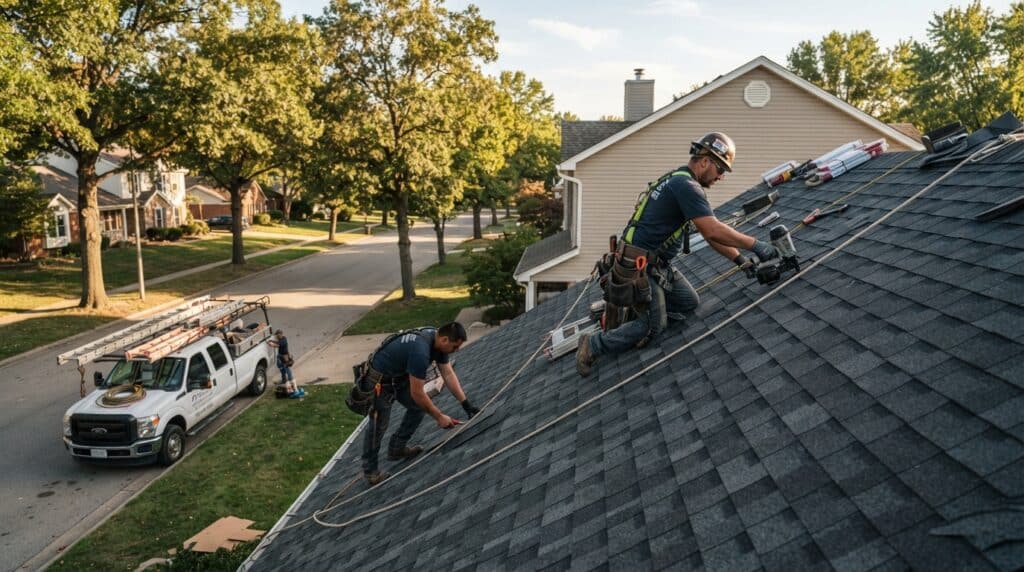
If you run a roofing company in the tri-state, roofing contractor insurance is less about one policy and more about a stack of coverages that work together. The right combination keeps a dropped tool, an injured crew member, or a truck accident from turning into a business-ending bill. This guide covers what a roofing business needs in Indiana, Kentucky, and Illinois, including one rule national carrier pages tend to skip: Indiana requires workers’ compensation from your very first employee.
Key Takeaways
- Roofing insurance is a package, not one policy. Most roofing businesses carry general liability, workers’ compensation, commercial auto, tools and equipment (inland marine) coverage, and a commercial umbrella.
- Indiana requires workers’ comp from your first employee, with no minimum head count. That is stricter than the national norm, where many states only require it above three to five employees.
- Roofing is a high-risk trade on the government’s own data. Construction and extraction workers had 1,032 fatal work injuries in 2024, and 370 of those were fatal falls, slips, and trips.
- Fall protection is required at six feet in construction. OSHA sets the six-foot fall protection threshold, so how you manage height affects both safety and what a carrier charges you.
- General contractors gate the job on paperwork. Most require a certificate of insurance, additional insured status, and a waiver of subrogation before a roofing crew can start.
- Tri-state work adds complexity. Running crews and trucks across Indiana, Kentucky, and Illinois raises workers’ comp and commercial auto questions a single-state contractor never faces.
The Core Insurance Policies a Roofing Business Needs
A roofing business typically needs five core coverages: general liability, workers’ compensation, commercial auto, tools and equipment (inland marine) coverage, and a commercial umbrella. Each one answers a different roofing risk, from a dropped tool below an occupied home to an injured crew member on a steep pitch. The table below maps them out.
| Policy | What it covers | Why it matters for roofing | Verified anchor |
|---|---|---|---|
| General liability | Third party bodily injury and property damage caused by your work, plus legal defense. | Roofers work at height above occupied homes and businesses. A dropped tool on a client’s car or debris that injures a passerby is a classic roofing claim. | III |
| Workers’ compensation | Medical care and a portion of lost wages for an injured employee regardless of fault, plus death benefits to the family. | Indiana requires it from the first employee, with no minimum. Roofing carries the fall exposure OSHA regulates at six feet, and construction falls are a leading share of construction deaths. | III; Indiana Code; OSHA; BLS |
| Commercial auto | Third party bodily injury and property damage from vehicles owned or used by the business. | Trucks haul crews, materials, dumpsters, and ladder racks between sites daily, often across the tri-state. | III |
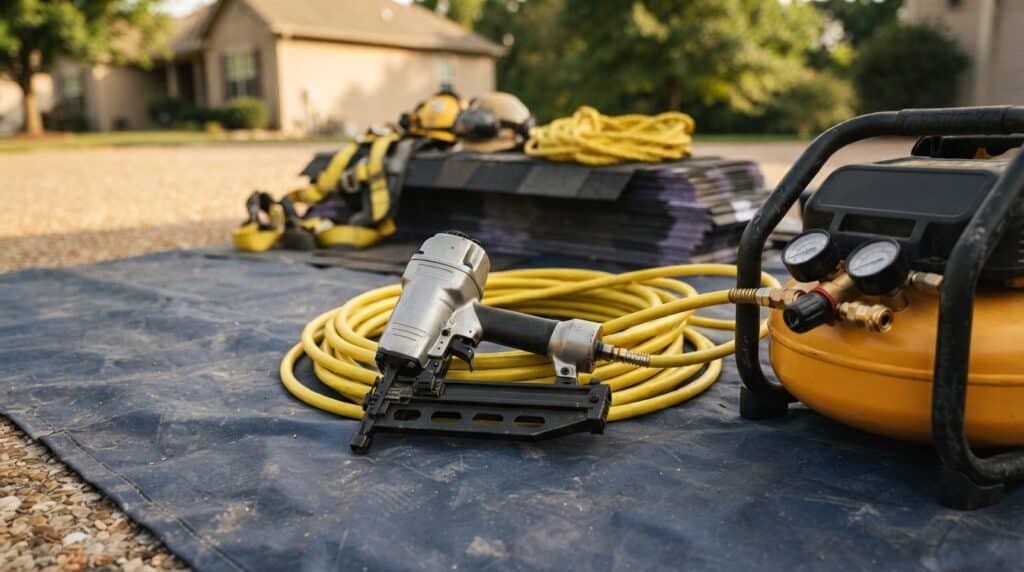
| Tools and equipment (inland marine) | Movable tools, equipment, and materials on the job, in transit, or in storage (add-on to the property program). | Nail guns, compressors, harnesses, and staged materials are high value and mobile, so they sit outside standard fixed location property limits. | Inland marine guide |
| Commercial umbrella | Extra liability limits above the general liability and auto policies. | General contractors and commercial clients frequently require higher limits than a base policy provides before a roofer can start work. A commercial umbrella adds capacity above your general liability and auto limits. | III |
Most roofers start with general liability insurance, which responds when your work causes third party injury or property damage. From there, commercial auto insurance covers the trucks that move crews and materials, inland marine coverage for contractors’ tools and equipment protects the nail guns and compressors that travel from job to job, and a commercial umbrella adds limits on top when a claim runs past your base policies. Workers’ compensation gets its own section below, because Indiana treats it differently than most states.
Why Roofing Is Treated as a High-Risk Trade
Roofing sits at the high-risk end of construction because the core of the job happens at height. That is not a marketing line. It shows up in federal safety data and in how carriers price roofing work.
Three facts define roofing’s risk profile:
- Construction and extraction workers experienced 1,032 fatal work injuries in 2024, and 370 of those were fatal falls, slips, and trips (down from 400 in 2023).
- OSHA requires fall protection at six feet in the construction industry, and falls are among the most common causes of serious work-related injuries and deaths.
- The all-worker fatal injury rate was 3.3 per 100,000 full-time equivalent workers in 2024, so construction sits well above the baseline.
Because roofing carries this exposure, do not assume a general contractor policy written for lower-risk trades automatically covers roofing work at height. Confirm with your agent that your policy actually covers your roofing operations, including the heights and pitches your crews handle.
Indiana Requires Workers’ Compensation From Your First Employee
In Indiana, workers’ compensation is required from your first employee. There is no minimum head count. Under IC 22-3-5-1 and IC 22-3-2-2, every employer must insure and keep insured its workers’ compensation liability, so a roofing company with even one W-2 crew member needs coverage in place.
This is stricter than the national baseline. Nationally, many states only require workers’ compensation once a business passes a threshold of three to five employees. That national rule does not apply in Indiana, so do not assume a small crew is exempt.
A few Indiana specifics matter for roofing businesses:
- Owners can opt in. Sole proprietors, partners, and LLC members are generally excluded, but they can elect to include themselves under the policy.
- Subcontractors need proof. Independent contractors can file a certificate of exemption with the Indiana Worker’s Compensation Board. If your roofing company uses subs, collect proof of their coverage or exemption before they work, or their payroll can land back on your policy at audit.
- Non-compliance has teeth. Failing to carry or prove coverage can bring civil penalties, so keeping documentation current is part of staying compliant.
If you want the wider picture of what the state expects, our guide to Indiana’s small business insurance requirements covers the rules that apply beyond roofing. For coverage specifics, start with workers’ compensation insurance and confirm the class codes match the work your crews actually do.
What General Contractors Require Before a Roofing Crew Can Start
Before a roofing crew sets foot on a commercial or GC-run job, the general contractor usually requires proof of coverage in a specific form. Missing any one piece can keep your bid out of the running or hold up your start date.
- Certificate of insurance (COI): A one-page summary proving your policies are active, with coverage types, limits, and dates. Learn what belongs on a certificate of insurance so you can spot a request that your current policy will not satisfy.
- Additional insured: The GC asks to be added to your general liability policy so your coverage responds if they are pulled into a claim tied to your work.
- Waiver of subrogation: The GC asks your insurer to give up its right to recover from them after paying a claim connected to your work.
These endorsements carry real cost and coverage implications, so line them up with your agent before you sign. Our guide to builders risk coverage in Indiana walks through additional insured and waiver of subrogation language in a project context.
Running Crews and Trucks Across Indiana, Kentucky, and Illinois
If your roofing company works across the tri-state, workers’ compensation and commercial auto get more complicated. Coverage that is fine for Indiana-only work can leave gaps the moment a crew or a truck crosses into Kentucky or Illinois.
- Workers’ comp follows the work. Comp rules and rates are tied to where work happens and where employees are based. Your policy needs to be set up to respond in every state your crews work, not just your home state, so tell your agent which states you take jobs in.
- Commercial auto should not stop at the state line. Confirm your commercial auto policy covers the trucks wherever they operate across the tri-state, rather than being written around a single state’s use.
- Licensing and bonding vary by place. In Indiana, roofing licensing and registration are set locally, and rules differ across state and city lines. Some jurisdictions require permits or surety bonds and others do not, so confirm the requirements in each city, county, and state where you plan to work before you send a crew.
What Drives the Cost of Roofing Contractor Insurance
There is no flat price for roofing contractor insurance. What you pay depends on your specific operation, and understanding the drivers helps explain why two roofing companies can get very different numbers. National quote pages skip this. Here is what actually moves the premium.
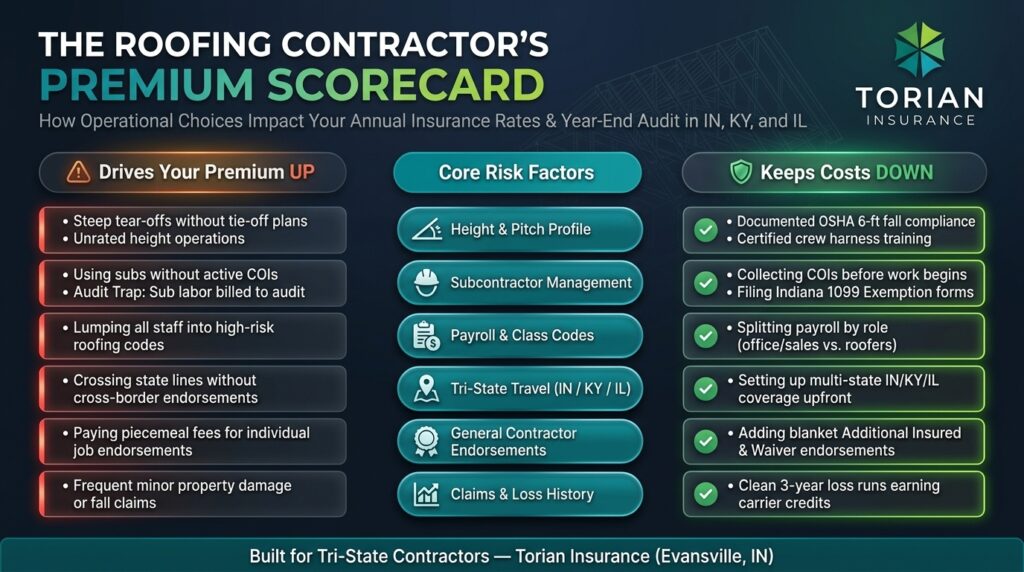
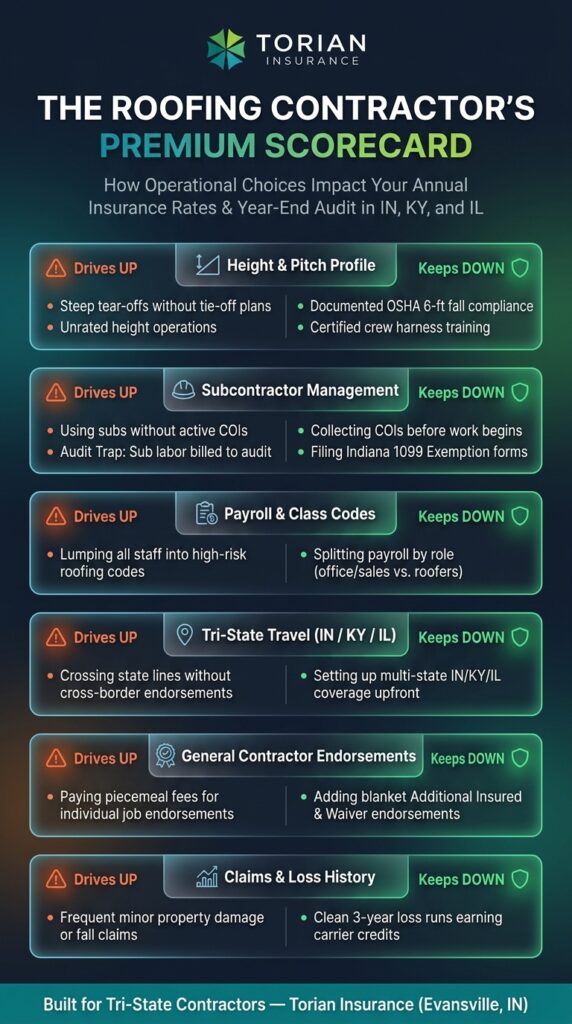
- Payroll and class codes: Workers’ comp is rated on payroll and the classification codes assigned to your work, and roofing codes carry higher rates than lower-risk trades.
- Type of work and height: Steep tear-offs, multi-story commercial, and high-pitch work read as higher exposure than low-slope, ground-level jobs.
- Residential and commercial mix: The balance of your work affects both your liability and your workers’ comp exposure.
- Claims history: Prior injury and liability claims raise rates, and a clean record helps.
- Subcontractor use: Uninsured subs can be added to your payroll base at audit, which raises cost. Collecting certificates from your subs protects your number.
- Limits and endorsements: Higher liability limits, added insureds, and waivers all factor in, especially when a GC requires them.
Because roofing is rated on payroll and class codes, an annual premium audit is normal. Keep accurate payroll and subcontractor records so the audit reflects your real exposure rather than an estimate.
How Torian Insurance Helps Roofing Businesses in the Tri-State
Torian Insurance is an independent agency, not a carrier, so we shop multiple carriers to build a roofing program around how your business actually operates. As Evansville’s largest locally owned independent insurance agency, we have worked with tri-state contractors since 1923, and we know the coverage general contractors in this region ask for and the workers’ compensation rules Indiana enforces.
For a roofing business, that means matching general liability, workers’ compensation, commercial auto, tools and equipment coverage, and an umbrella to your crews, your trucks, and your job mix. It also means turning around the documentation you need to win work, including certificates of insurance, additional insured endorsements, and waivers of subrogation, often the same day you need them.
Frequently Asked Questions About Roofing Contractor Insurance
What insurance does a roofing contractor need?
Most roofing businesses need general liability, workers’ compensation, commercial auto, tools and equipment (inland marine) coverage, and a commercial umbrella. General liability handles third party injury and property damage from your work, workers’ comp covers injured employees, and the others protect your vehicles, gear, and higher liability limits. The exact mix depends on your crew size, job types, and what your contracts require.
Do roofers need workers’ compensation insurance in Indiana?
Yes. Indiana requires workers’ compensation from your first employee, with no minimum head count. That is stricter than many states, which only require it above a threshold of three to five employees. Sole proprietors and partners are generally excluded but can elect to include themselves.
How much does roofing contractor insurance cost?
There is no flat rate. Cost depends on your payroll and workers’ comp class codes, the type and height of work you do, your residential and commercial mix, your claims history, whether you use subcontractors, and the coverage limits your contracts require. Because roofing is rated on payroll and class codes, expect an annual premium audit, and keep accurate records so it reflects your real exposure.
Do you need a license to be a roofer in Indiana?
Indiana does not issue a statewide roofing contractor license. Roofing licensing and registration are handled by cities and counties, and some jurisdictions run stricter programs than others. Check with the local building department where you plan to work, and confirm whether a permit, registration, or bond is required before you start.
Does a roofing company need commercial auto insurance?
Almost always. If your business owns or uses trucks and vans to move crews, materials, dumpsters, or ladder racks, a personal auto policy will not cover accidents during business use. Commercial auto fills that gap, and it should be set up to cover your vehicles wherever they operate across the tri-state.
Build Coverage Around Your Roofing Operation
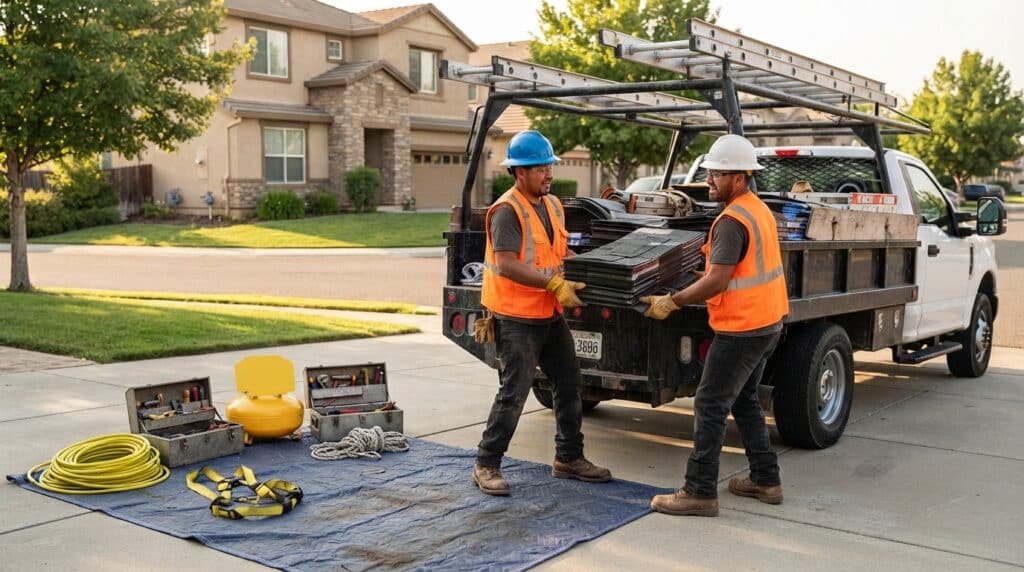
Roofing contractor insurance works best when the coverage is built around your actual crews, trucks, and contracts, not a generic template. If you run a roofing business in Indiana, Kentucky, or Illinois, the team at Torian Insurance can review your operation and help you put the right stack in place. Learn more about contractor insurance in Indiana, or reach out to talk with a local agent.