Most people assume their homeowners policy covers almost anything that could happen to their house. It doesn’t. Understanding what homeowners insurance doesn’t cover is the difference between a smooth claim and a surprise bill, and for homeowners across the tri-state area of Indiana, Kentucky, and Illinois, the gaps that matter most are surprisingly common: flood, earth movement, gradual damage, high-value items, and business use of your home.
Key Takeaways
- A standard homeowners policy is designed for sudden, accidental events. It excludes several everyday risks, including flood, earthquake and earth movement, gradual damage, and business activity.
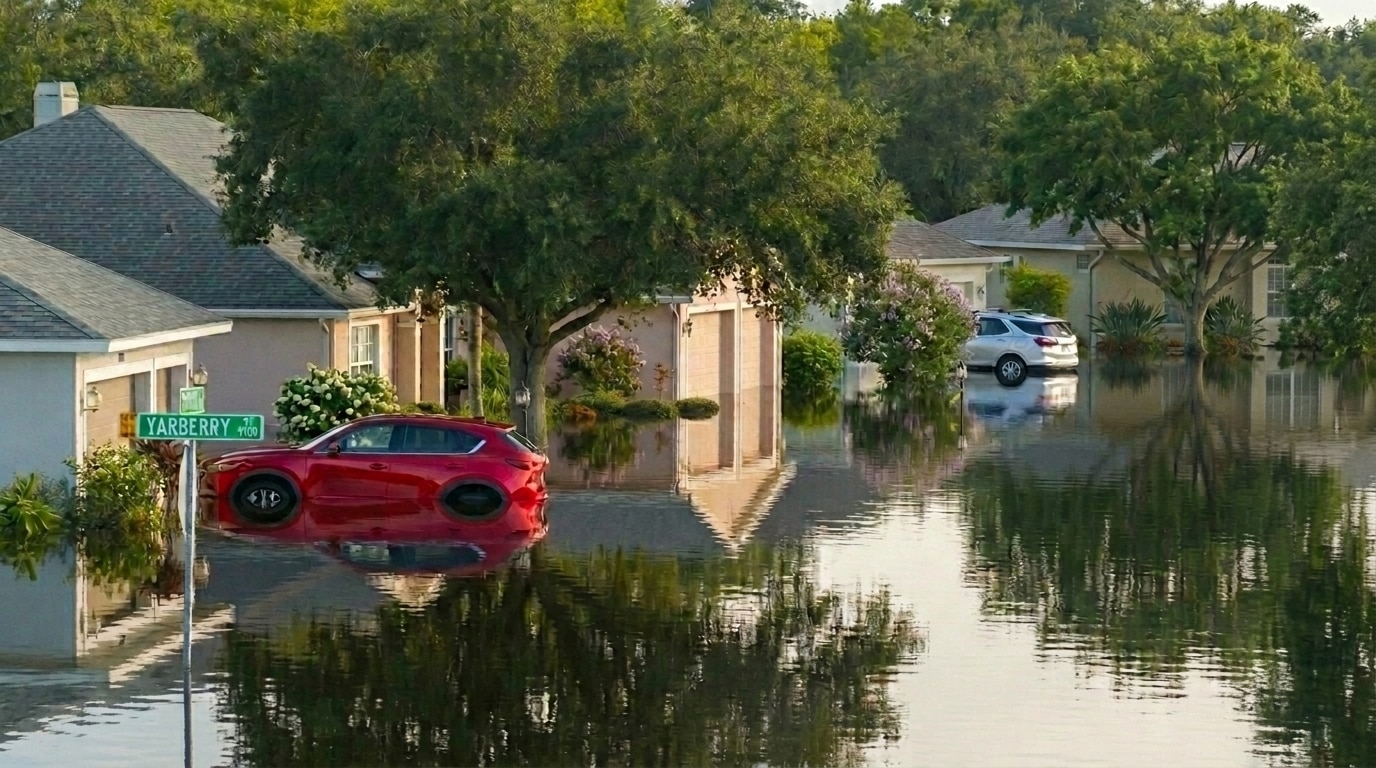
- Flood is never covered by a standard homeowners policy. Because 90% of U.S. natural disasters involve flooding, inland homes across the tri-state near the Ohio and Wabash rivers often need separate flood insurance through the NFIP or a private insurer.
- Mine subsidence, the collapse of an underground coal mine, is excluded from standard policies. Indiana, Kentucky, and Illinois each run a mine subsidence program, so the coverage is available as an add-on in eligible counties across the tri-state.
- Damage from neglect, wear and tear, mold, and pests is excluded because it is treated as preventable maintenance, and neglected-maintenance claim denials are rising.
- Most exclusions can be closed with an endorsement (an add-on to your policy) or a separate policy, from flood and water-backup coverage to scheduled coverage for jewelry.
- An independent agent can review your policy, identify the gaps that actually apply to your home and location, and match you with coverage to fill them.
What Counts as an Exclusion, and Why Standard Policies Have Them
An exclusion is a risk your homeowners policy specifically will not pay for. Every policy lists them, right alongside the perils it does cover. Standard policies exclude certain risks because those risks are either predictable, preventable, or catastrophic enough to need their own dedicated coverage.
Two terms make the rest of this guide easier to follow. An endorsement is an add-on that expands your existing policy to cover something it otherwise wouldn’t. A separate policy is standalone coverage you buy in addition to your homeowners policy, the way flood insurance works. Whether a gap is best closed by an endorsement or a separate policy depends on the risk.
It also helps to know how your policy decides what’s covered in the first place. Our guide to named perils versus open perils explains the two structures: a named-perils policy covers only the events it lists, while an open-perils policy covers everything except what it excludes. Either way, the exclusions below are where the coverage stops.
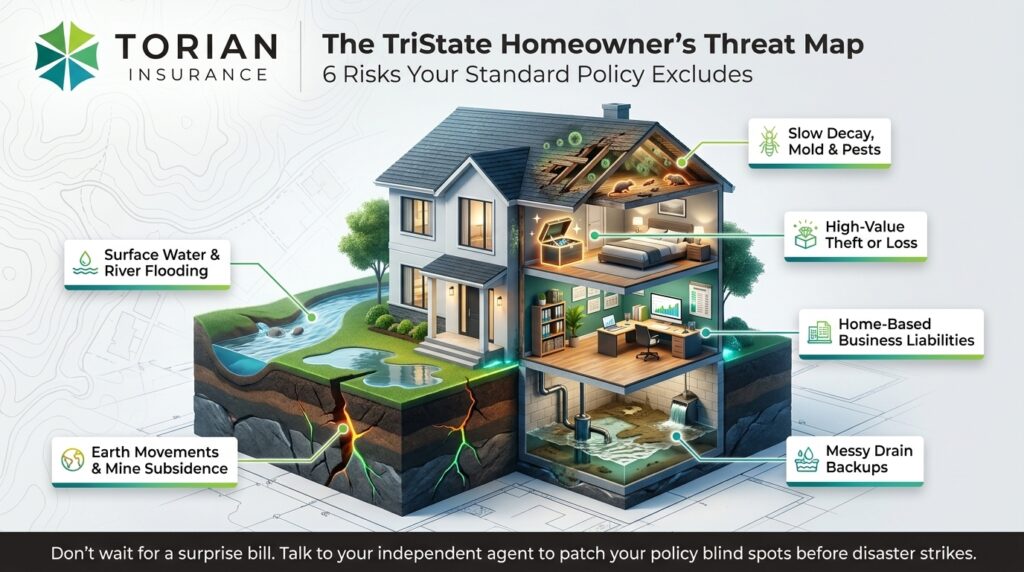
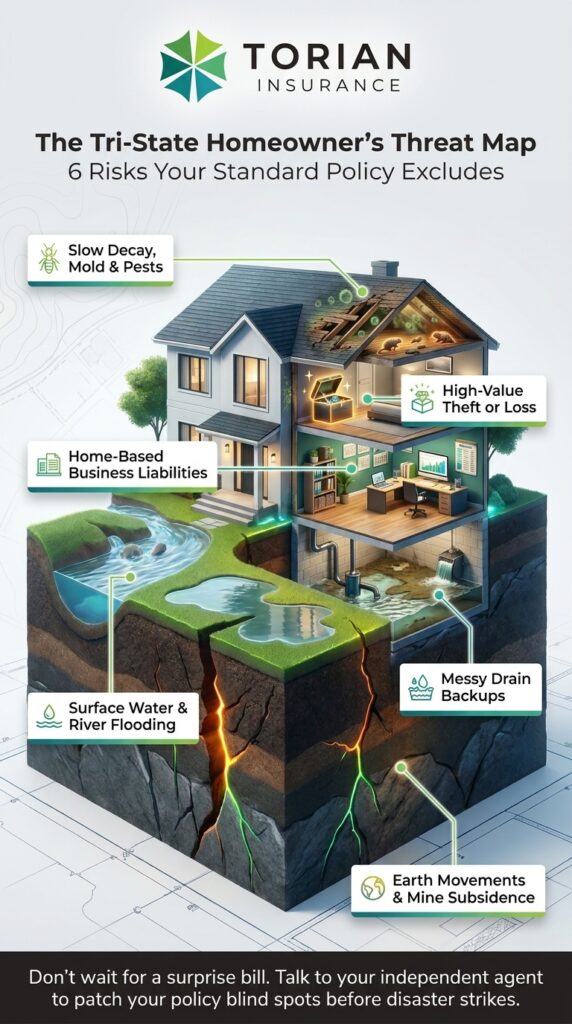
What Homeowners Insurance Doesn’t Cover: The Short List
Here are the exclusions Indiana homeowners run into most often, why each one is excluded, and how to cover it. The categories that follow explain the ones that cause the most confusion.
| Not covered by a standard policy | Why it’s excluded | How to cover it |
| Flood | Excluded on every standard homeowners policy. | A separate flood policy through the NFIP or a private insurer. This matters near the Ohio River even outside a mapped high-risk zone. |
| Earthquake and earth movement (landslide, mine subsidence, sinkholes) | Earth movement is excluded. | An earthquake endorsement or separate policy. Indiana, Kentucky, and Illinois each run a mine subsidence program that covers mine collapse in their eligible counties. |
| Sewer or drain backup | Not covered by a typical policy, and not covered by flood insurance either. | Add a water backup endorsement. |
| Mold | Not covered as gradual damage. It is only covered when it results from a covered peril, such as a burst pipe. | Fix the water source quickly, and ask about a limited mold endorsement. |
| Termites and pests | Excluded as preventable maintenance. | Prevention and upkeep. This is a maintenance issue, not an insurable one. |
| Wear, tear, and neglect | Excluded, and neglected-maintenance claim denials are rising. | Routine maintenance. Keeping records of repairs and inspections helps protect the rest of your coverage. |
| High-value jewelry and valuables | A standard policy caps what it pays for jewelry and other valuables. | Schedule the items with a personal articles floater, which insures named items for their full appraised value. |
| Business use of your home | A standard policy sharply limits coverage for business property and generally excludes business liability. | A homeowners endorsement, an in-home business policy, or a business owners policy (BOP). |
| HOA and condo master-policy gaps | The association’s master policy does not cover your unit interior, your belongings, or a full loss assessment. | An HO-6 condo policy plus a loss assessment endorsement. |
| War, nuclear hazard, and terrorism | Generally excluded. | Specialized coverage. This rarely applies to a typical household. |
Anchor stat: 90% of U.S. natural disasters involve flooding, yet standard homeowners policies don’t cover it (Insurance Information Institute).
Natural Disasters Standard Policies Exclude: Flood and Earthquake
Two of the biggest natural disaster risks are excluded from every standard homeowners policy: flood and earthquake. Both fall outside the covered perils, and both need their own coverage. For tri-state homeowners, the local versions of these risks (river flooding and mine subsidence) are easy to overlook and expensive to face uninsured.
Flooding and the Ohio River: Why Inland Tri-State Homes Still Need Flood Coverage
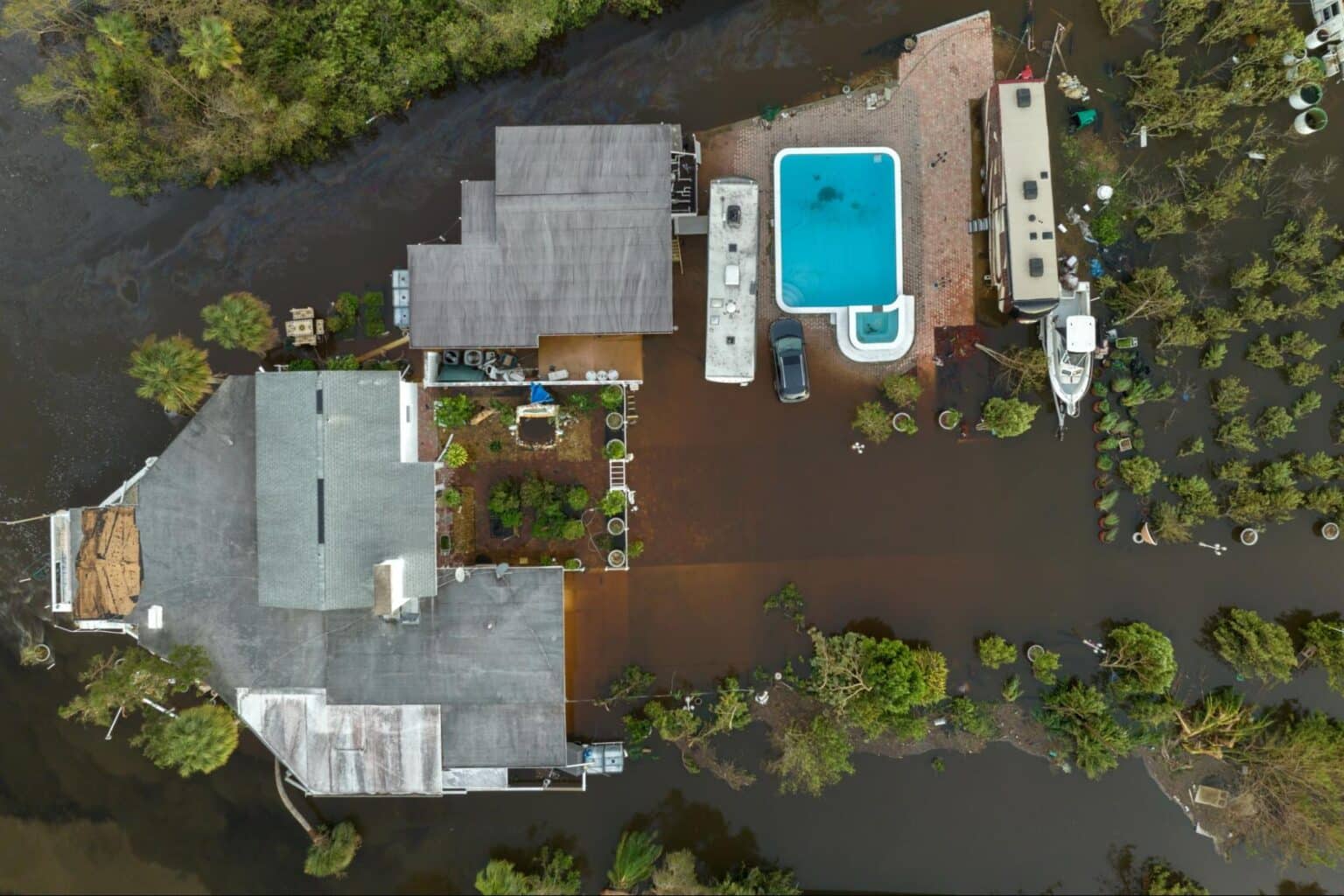
Flood damage is excluded under standard homeowners and renters policies. Coverage is available only as a separate policy, either through the National Flood Insurance Program (NFIP) or a private flood insurer.
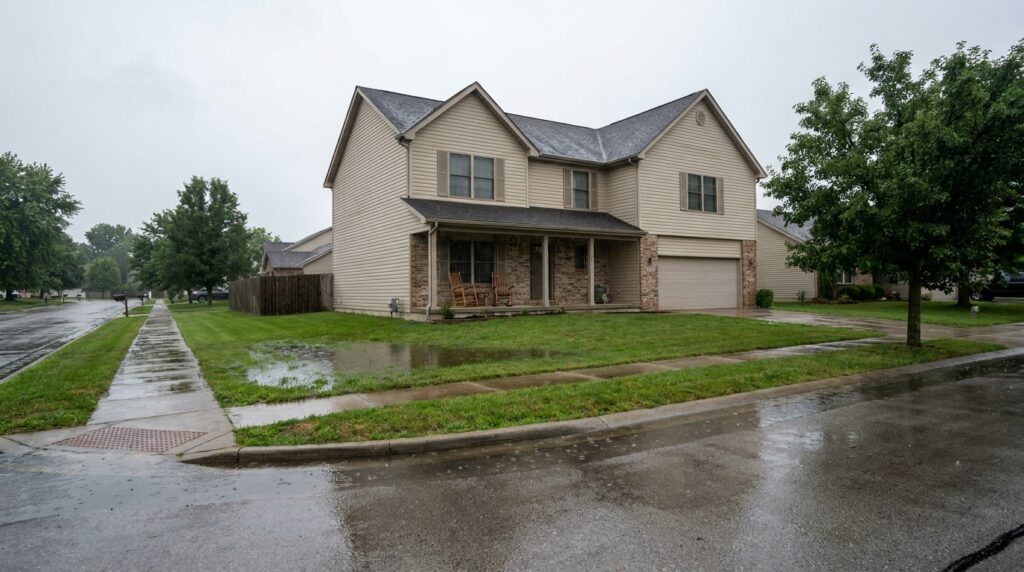
The mistake many homeowners make is assuming flood risk is only a coastal or floodplain problem. It isn’t. As 90% of U.S. natural disasters involve flooding, and the Ohio and Wabash rivers put communities across Indiana, Kentucky, and Illinois at real risk, even homes well outside a mapped high-risk zone can flood.
Mark Friedlander, senior director at the Insurance Information Institute, notes in Newsweek in 2025 that every part of the country faces flood risk. For a homeowner in Evansville, across the river in Henderson, or anywhere along the Ohio or Wabash, the practical takeaway is simple: a homeowners policy will not pay for flood damage, so flood coverage has to be added separately.
Earthquake, Earth Movement, and Mine Subsidence Across the Tri-State
Earthquake and other earth movement are also excluded from standard policies. Earthquake coverage is available as an endorsement or a separate policy. The category that catches tri-state homeowners off guard, though, is mine subsidence.
Mine subsidence is the collapse of an abandoned underground coal mine, which can shift or crack the ground (and the home) above it. Standard homeowners policies exclude it as a form of earth movement. Because the Illinois Coal Basin runs under all three states Torian serves, each state runs its own mine subsidence program to fill the gap:
- Indiana: the Indiana Mine Subsidence Insurance Fund covers 26 southwestern counties, including Vanderburgh, Warrick, and Gibson.
- Kentucky: the Kentucky Mine Subsidence Insurance Fund covers 37 counties, including Henderson County, directly across the Ohio River from Evansville.
- Illinois: the Illinois Mine Subsidence Insurance Fund covers 34 counties, where the coverage is included automatically unless you waive it in writing.
In every case the coverage is added to your existing policy, not built into it. Our full guide to mine subsidence and your home walks through who’s eligible in each state and how the coverage is added.
Damage From Neglect, Wear and Tear, Mold, and Pests
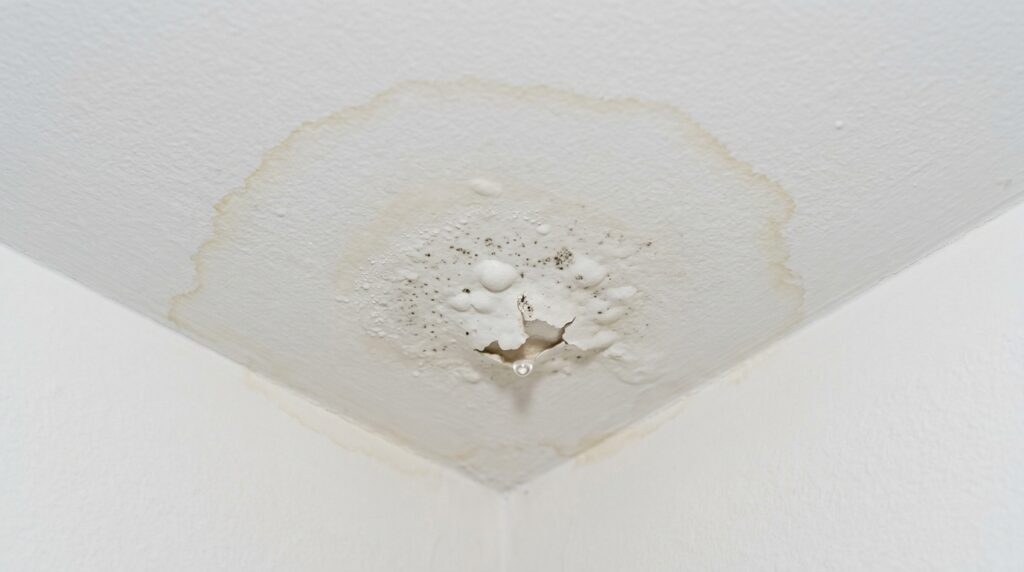
Homeowners insurance covers sudden, accidental damage, not the slow kind. Damage from lack of maintenance, ordinary wear and tear, mold, and pests is excluded, because keeping your home in good repair is considered your responsibility.
This is one of the most common reasons a claim gets denied. A roof that fails after years of visible deterioration, a slow leak that turns into rot, or a termite problem left unaddressed will usually not be covered. Mold is a good example of the line insurers draw:
- Covered: mold that results from a sudden covered peril, such as water damage from a burst pipe.
- Not covered: mold that develops gradually from humidity, a slow leak, or deferred repairs.
- Not covered: termites, other pests, and general wear and tear, all treated as preventable maintenance.
The practical defense is upkeep and documentation. Routine maintenance keeps these problems from starting, and keeping records of inspections and repairs helps protect the covered parts of your policy if you ever do file a claim.
Limits on Jewelry and Other High-Value Items
Your policy doesn’t exclude jewelry outright, but it caps how much it will pay for it. Standard policies apply special limits to categories like jewelry, watches, furs, fine art, and collectibles, so a valuable engagement ring or watch can be worth far more than the policy will reimburse if it’s stolen or lost.
The fix is scheduled personal property, also called a personal articles floater: an endorsement that insures specific named items for their full appraised value, often with no deductible and broader protection. Our post on whether your homeowners policy covers your jewelry explains how the sub-limits work, and our valuable items and jewelry insurance page covers how to schedule your pieces.
Business Use of Your Home
If you run a business from home, your homeowners policy probably leaves a gap. A standard policy sharply limits coverage for business property and generally excludes business liability, so inventory, equipment, and any claim tied to your work may not be covered.
This affects more people than it seems: consultants, online sellers, contractors who store tools and materials at home, and anyone who sees clients at the house. Depending on the business, the gap is closed with a homeowners endorsement, an in-home business policy, or a business owners policy (BOP). Our guide to home-based business insurance breaks down which option fits which situation.
HOA and Condo Coverage Gaps
If you own a condo or live in an HOA community, the association’s master policy does not cover everything. It typically insures the building’s exterior and shared areas, not the interior of your unit, your belongings, or your full share of a large loss.
Two terms matter here. An HO-6 is a condo owner’s policy that covers your unit’s interior and your personal property. A loss assessment is your share of a cost the HOA passes on to owners after a large claim, which can exceed what a basic policy pays. A loss assessment endorsement raises that limit. Our post on HOA master-policy gaps shows how to line your HO-6 up with the association’s coverage so nothing falls through the cracks.
Sewer and Drain Backup: A Common Exclusion Worth Adding
Water that backs up through drains, toilets, or a sump pump is not covered by a typical homeowners policy, and it isn’t covered by flood insurance either. It’s an easy gap to miss and an inexpensive one to close with a water backup endorsement. Our post on sewer line damage and your homeowners policy explains what the endorsement covers and when it’s worth adding.
How Torian Insurance Helps
As an independent agency based in Evansville, we don’t work for a single insurance company. We shop multiple carriers on your behalf, which means we can look at your home, your location, and your budget, then match you with a policy and the specific endorsements that close your gaps.
A lot of what we do is simply reading a policy the way it will read at claim time. We can point out where a standard policy stops, whether that’s flood coverage for a home near the Ohio River, mine subsidence in one of the eligible counties, scheduled coverage for a ring, or a water backup endorsement, and help you decide which gaps are worth filling for your situation. We serve homeowners across Indiana, Kentucky, and Illinois.
Frequently Asked Questions About Homeowners Insurance Exclusions
What is not covered by home insurance?
The most common exclusions are flood, earthquake and earth movement, sewer or drain backup, mold, termites and pests, and ordinary wear and tear. Standard policies also cap coverage for high-value items like jewelry and limit coverage for business use of your home. Most of these gaps can be filled with an endorsement or a separate policy.
Does homeowners insurance cover flood damage?
No. Flood damage is excluded from every standard homeowners policy. You need a separate flood policy through the NFIP or a private insurer. This is worth considering even inland, because most U.S. natural disasters involve flooding and river communities across the tri-state face genuine flood risk.
Does homeowners insurance cover damage over time, like wear and tear?
No. Gradual damage from wear and tear, lack of maintenance, mold, or pests is excluded, because upkeep is considered the homeowner’s responsibility. Insurance is meant for sudden, accidental losses. Mold is only covered when it results from a covered peril, such as a burst pipe.
What is the most common reason a homeowners claim is denied?
Two big ones are excluded perils and neglect. A claim for flood, earthquake, or sewer backup is denied because those risks aren’t covered by a standard policy, and a claim for damage that built up over time is denied as a maintenance issue. Neglected-maintenance denials have been rising, which is why routine upkeep and good records matter.
How do I cover something my policy excludes?
Most exclusions are closed one of two ways: an endorsement that adds coverage to your existing policy (for example, water backup or scheduled jewelry), or a separate policy for a major excluded risk (like flood, earthquake, or mine subsidence). An independent agent can tell you which approach fits each gap.

Review Your Policy Before You Need It
The gaps in a homeowners policy are easiest to fix before a loss, not after. Knowing what your policy excludes, and which of those gaps actually apply to your home, puts you in control of the decision. If you’re not sure where your coverage stops, the team at Torian Insurance can review your policy and help you find the right fit. Contact Torian Insurance to talk through your coverage with a local agent.