

If you own a condo, your association’s master policy covers the building, but it stops at your unit. Condo insurance, the HO-6 policy that fills that gap, is what protects the inside of your unit, your belongings, and you. This guide explains what an HO-6 covers, how your association’s master policy changes what you need, and what Indiana law actually requires.
Key Takeaways
- Condo insurance is an HO-6 policy. It covers your unit’s interior, your personal property, your liability, loss of use, and loss assessments. Your association’s master policy covers the building and common areas, not your unit.
- Your master policy type sets how much interior coverage you need. A “bare walls-in” master policy leaves finishes and fixtures to you. An “all-in” policy may cover original finishes, but you still insure your upgrades.
- Read your association’s declaration first. It tells you exactly where the master policy stops and your HO-6 begins.
- Loss assessment is the gap most owners miss. If a common-area loss exceeds the master policy limit, or the master deductible is charged back after a claim, your share can be assessed to you. Standard HO-6 forms often include only about $2,000, which is usually worth raising.
- Indiana law requires your association to insure the shared property. Under Indiana Code 32-25-8-9, the association must carry a master casualty policy at full replacement value plus a master liability policy. It does not require the association to insure the inside of your unit.
- An unendorsed HO-6 is a named-perils policy. Upgrading to special perils, and adding a separate flood policy, closes the most common gaps.
Who Insures What: Your Master Policy vs. Your HO-6 Condo Insurance
Condo insurance, also called an HO-6 policy, is the individual policy a condo owner buys to cover the parts of a condo the association’s master policy does not. The simplest way to understand it is to see the split. Your association’s master policy insures the building and shared spaces. Your HO-6 insures your unit’s interior and everything you own inside it.
The table below shows where one policy ends and the other begins.
| Item | Association master policy | Your HO-6 | Notes / verified anchor |
|---|---|---|---|
| Building structure, roof, exterior, foundation | Master policy | Not your HO-6 | Indiana requires the association to insure common-area structures at full replacement value (IC 32-25-8-9) |
| Common areas and amenities (halls, elevators, pool) | Master policy | Not your HO-6 | Association master casualty and liability (IC 32-25-8-9) |
| Unit interior finishes (drywall surface, flooring, cabinets, fixtures) | Depends on master policy type | Your HO-6 (Coverage A) if bare walls-in | Bare walls-in: you insure finishes. All-in: the master may cover original finishes (III; IRMI) |
| Upgrades and improvements you or a prior owner made | Usually not covered | Your HO-6 | Master policies commonly leave owner upgrades to your HO-6 (IRMI) |
| Personal property and belongings | Not covered | Your HO-6 (personal property) | Standard limits can be low for jewelry or art; schedule those separately |
| Personal liability (someone hurt inside your unit) | Not covered (master covers common-area liability) | Your HO-6 (personal liability) | The master policy covers liability in shared spaces, not inside your unit |
| Loss of use (unit uninhabitable after a covered loss) | Not covered | Your HO-6 (loss of use) | Pays temporary housing while your unit is repaired; limits vary by policy (III) |
| Loss assessment (your share of a common loss over the master limit, or the master deductible) | Master pays to its limit; excess assessed to owners | Your HO-6 loss assessment coverage | Default often about $2,000; raise via the HO 04 35 endorsement (IRMI) |
| Flood | Not covered by the standard master property policy | Not covered by HO-6 | Separate NFIP or private flood policy |
| Earthquake | Not typically covered | Not typically covered | Separate endorsement or policy |
Your association’s declaration is the source of truth. Where the two policies depend on each other, your master policy type (below) decides who pays. A condo policy works much like a standard homeowners (HO-3) policy, but it is scaled to a unit owner who shares the structure rather than owning it top to bottom. It also differs from an HO-4 renters policy, which covers a tenant’s belongings and liability but not the interior structure you are responsible for as an owner.
This guide assumes you live in your condo. If you rent your unit to tenants, an owner-occupied HO-6 is generally not the right policy, and a landlord policy applies instead.
Bare Walls-In vs. All-In: How Your Master Policy Type Changes Your Coverage
The single biggest factor in how much interior coverage you need is the type of master policy your association carries. It determines where the building’s coverage stops and yours begins. There are two common types to know.
- Bare walls-in: The master policy covers the structure up to the unfinished interior surfaces. You insure everything from the drywall in: finishes, flooring, cabinets, fixtures, and built-ins. This is the type that requires the most interior (Coverage A) coverage on your HO-6.
- All-in (sometimes called single-entity): The master policy may cover the original finishes and fixtures the builder installed. You still insure your belongings, your liability, and any upgrades or improvements.
Regardless of type, the upgrades you or a previous owner added commonly fall to your HO-6, so a renovated kitchen or upgraded flooring can be your responsibility. You cannot tell which type you have from your dues statement. Ask your association or property manager, or read the master policy’s declaration page, before you set your HO-6 limits. For a closer look at where master policies fall short, see this breakdown of HOA master policy gaps.
What Your HO-6 Condo Insurance Covers
A condo insurance policy bundles several coverages, much like a homeowners policy, but scaled to a unit owner. Here is what each part does.
Interior and Improvements (Coverage A)
Coverage A pays to repair or replace the interior structure you are responsible for: drywall, flooring, cabinets, and built-in fixtures. Standard ISO HO-6 forms often start with only about $5,000 of Coverage A, which is rarely enough. Most unit owners are responsible for far more, so this limit usually needs to be raised to match your unit and your master policy type.
Personal Property
This covers your belongings: furniture, electronics, clothing, and more. Standard limits can be low for jewelry, art, and collections, so those are often worth scheduling separately so they are covered for their full value.
Loss of Use
If a covered loss makes your unit uninhabitable, loss of use (also called additional living expenses) helps pay for temporary housing and related costs while your unit is repaired.
Personal Liability
If someone is injured inside your unit, or you cause damage you are legally responsible for, personal liability coverage responds. The master policy covers liability in common areas, not inside your unit.
Loss Assessment Coverage: The Gap Most Condo Owners Miss
Loss assessment coverage pays your share when the association bills unit owners for a covered loss the master policy did not fully pay. It is the coverage owners most often overlook, and the one that produces the most surprise bills. Two situations trigger it most often.
- The loss exceeds the master policy limit. If a common-area loss runs past what the master policy pays, the association can assess the remainder across owners. Your loss assessment coverage pays your share.
- The master deductible is charged back. Master policy deductibles can be large, and after a claim the association may pass a portion to owners. In some cases a deductible tied to a claim involving your unit can be assessed to you.
Standard HO-6 forms usually include only about $2,000 of loss assessment coverage, and can be raised through the Supplemental Loss Assessment Coverage (HO 04 35) endorsement. Given how high master deductibles run, raising it is worth discussing with your agent. This is the gap that turns a building’s problem into your bill, and where condo owners face bigger surprises than buyers of almost any other personal policy.
Named Perils vs. Special Perils: Why an Unendorsed HO-6 May Not Be Enough
An unendorsed HO-6 is a named-perils policy, meaning it covers only the causes of loss specifically listed. Anything not named is not covered, which can leave gaps you would not expect. Water damage that reaches your unit from a roof leak, for example, may not be covered on a basic named-perils form. Upgrading your interior coverage to a special-perils (open-perils) basis covers any cause of loss except those specifically excluded, which is a meaningful upgrade for most condo owners.
What Condo Insurance Does Not Cover in Indiana
Like any policy, an HO-6 has exclusions. A few matter more than others for tri-state condo owners.
- Flood: Standard condo, homeowners, and renters policies do not cover flood damage. Flood coverage requires a separate policy from the National Flood Insurance Program (NFIP) or a private flood insurer, and condos are eligible for NFIP coverage. For owners near the Ohio River and the region’s low-lying areas, flood risk in Indiana is not hypothetical.
- Earthquake: Earthquake damage is not typically covered and requires a separate endorsement or policy.
- Wear and tear, pests, and intentional acts: Routine maintenance issues, insect or rodent damage, and intentional damage are excluded, the same as they are on a standard homeowners policy.

Is Condo Insurance Required in Indiana?
Indiana does not force an individual owner to buy condo insurance by statute, but two things usually make it required in practice: your association’s bylaws and your mortgage lender. Indiana law does, however, require your association to insure the shared property.
Under the Indiana Condominium Act, Indiana Code 32-25-8-9, the co-owners, through the association, must purchase a master casualty policy that provides fire and extended coverage at the full replacement value of the common areas, plus a master liability policy. What the statute does not do is insure the inside of your unit. That responsibility, and the coverage that goes with it, is yours, and it is exactly the gap your HO-6 is built to fill.
What Determines Your Condo Insurance Cost
There is no single price for condo insurance, because the cost is driven by your unit and the choices you make, not by a flat rate. A few factors move it more than others.
- Your unit’s value and interior: Higher-end finishes, upgrades, and square footage raise the amount of interior coverage you need.
- The coverage limits you choose: Higher Coverage A, personal property, liability, and loss assessment limits provide more protection and affect cost.
- Your deductible: A higher deductible generally lowers your premium, while a lower one raises it.
- Your master policy type: A bare walls-in master policy means you insure more of the interior, which affects how much HO-6 coverage you carry.
- Location and risk: Where your building sits, its construction, and local risk factors all play a role.
The most useful step is not chasing a number. It is matching your limits to what you are actually responsible for under your association’s declaration.
How to Get the Right HO-6 Policy
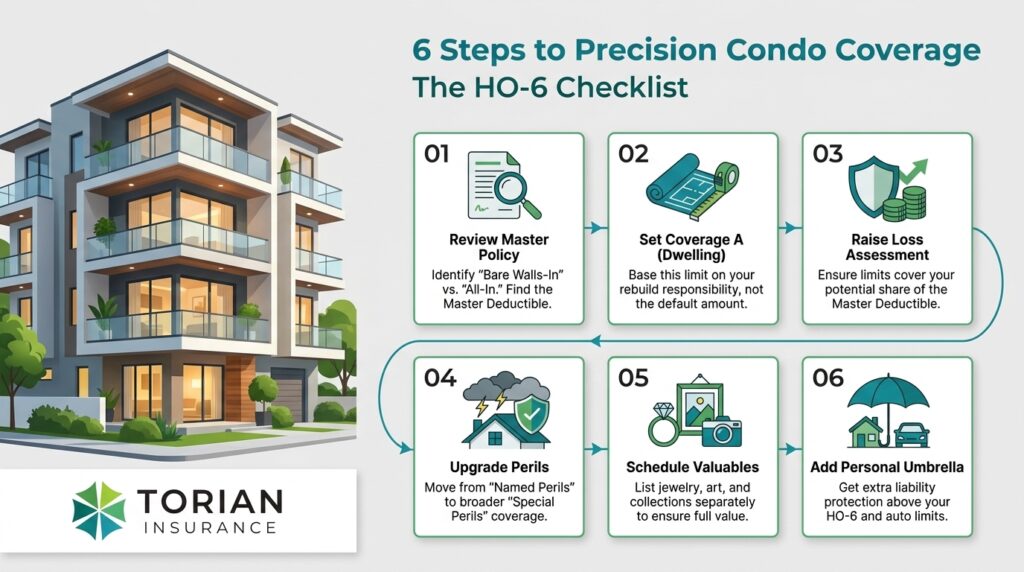
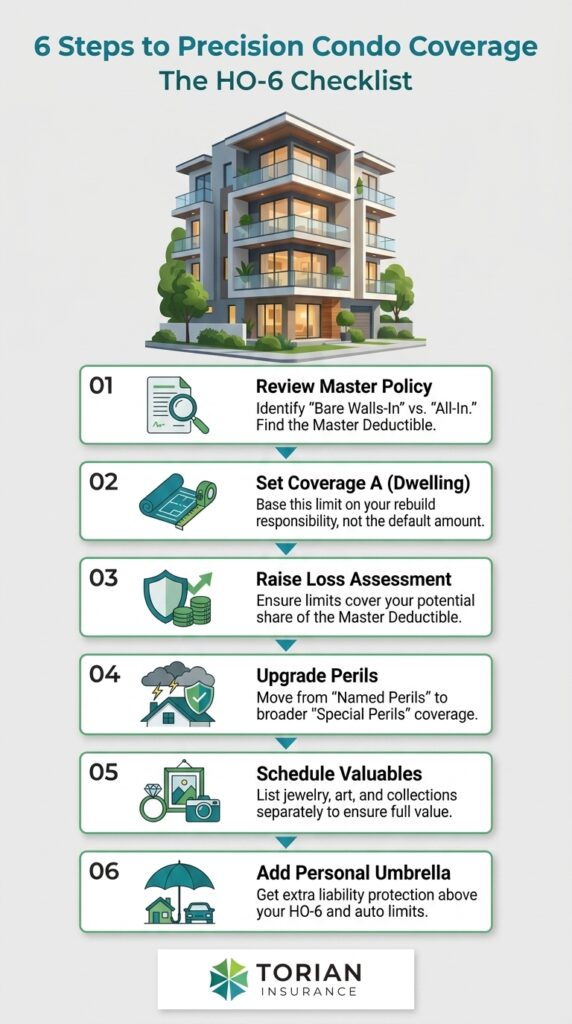
Getting the right condo insurance is less about price shopping and more about matching your coverage to your unit and your association’s documents. A short checklist covers most of it.
- Read your declaration and master policy. Confirm whether it is bare walls-in or all-in, and find the master deductible.
- Set your Coverage A from what you are responsible for. Use the responsibility split above to size your interior coverage, not the low default limit.
- Raise your loss assessment limit. The standard amount is often too low for real-world master deductibles.
- Add special perils. Move your interior coverage off a basic named-perils form.
- Schedule high-value belongings. Cover jewelry, art, and collections above standard limits.
- Consider a personal umbrella. If your assets exceed your liability limits, a personal umbrella policy adds a layer of liability protection above your HO-6 and auto coverage.
How Torian Insurance Helps
As an independent insurance agency, Torian Insurance is not a carrier and does not set premiums. We shop multiple carriers on your behalf, and for condo owners that means matching your HO-6 to the master policy your association actually carries.
In practice, we review your association’s declaration and master policy alongside your personal policy, identify where the coverage stops, and help you size your interior, loss assessment, and liability limits to fit. Founded in 1923, Torian is Evansville’s largest locally owned independent insurance agency, serving condo owners across Indiana, Kentucky, and Illinois.
Most owners do not discover a coverage gap until after a claim. A coverage review before a loss is the simplest way to avoid that surprise.
Frequently Asked Questions About Condo Insurance
What does HO-6 condo insurance cover?
An HO-6 policy covers the interior of your unit (Coverage A), your personal property, your personal liability, loss of use, and loss assessments. It does not cover the building structure or common areas, which your association’s master policy handles.
What is the difference between the condo association master policy and HO-6?
The master policy, paid through your association dues, insures the building and common areas. Your HO-6 insures your unit’s interior and your belongings. A common misconception is that the master policy covers everything inside your unit. In most cases it does not, which is why owners carry their own HO-6.
Does condo insurance cover water damage from another unit?
It can, but it depends on the cause of loss and your policy form. Sudden, accidental water damage is often covered, while a basic named-perils form may not respond to every scenario. Special-perils coverage and a clear understanding of your master policy help close these gaps.
How much condo insurance do I need?
Enough to rebuild your unit’s interior, replace your belongings, cover your liability, and cover your share of a potential loss assessment. The right amount depends on your master policy type and your association’s declaration, not a flat figure.
Does condo insurance cover floods?
No. Standard condo insurance excludes flood damage. You need a separate flood policy through the NFIP or a private insurer, which is worth considering for tri-state owners near the Ohio River.
Match Your Condo Coverage to Your Unit
Condo insurance is straightforward once you see the split: the master policy covers the building, and your HO-6 covers your unit and the parts of a shared loss that fall to you. The details that matter, your master policy type, your loss assessment limit, and your interior coverage, all come from your association’s documents.
If you are not sure whether your HO-6 matches your association’s master policy, the team at Torian Insurance can review both together and help you find the right condo insurance coverage for your unit. Reach out to talk with a local agent serving Evansville, Newburgh, and the tri-state.