
Shopping for auto coverage gets confusing fast, partly because the different types of car insurance all sound alike and partly because Indiana law only requires a slice of what most drivers actually need. This guide walks through every coverage type in plain language, anchored to Indiana’s rules and the real decision behind any policy: meeting the legal minimum versus carrying enough to protect what you own.
Key Takeaways
- Indiana requires a minimum of 25/50/25 in liability coverage: $25,000 for bodily injury per person, $50,000 per accident, and $25,000 for property damage.
- Indiana is an at-fault (tort) state, so the at-fault driver’s liability coverage generally pays for the other party’s injuries and vehicle damage.
- Liability is the only coverage Indiana legally requires, but it pays nothing toward your own car or injuries, which is why most drivers add collision, comprehensive, and uninsured/underinsured motorist coverage.
- Indiana insurers must offer uninsured and underinsured motorist coverage at limits equal to your liability limits unless you reject it in writing (IC 27-7-5-2).
- About 15.4% of US drivers were uninsured in 2023, one practical reason UM/UIM coverage matters.
- “Full coverage” is not an official policy type. It usually means liability combined with collision and comprehensive coverage.
What Does Car Insurance Cover? The Three Jobs Every Policy Does
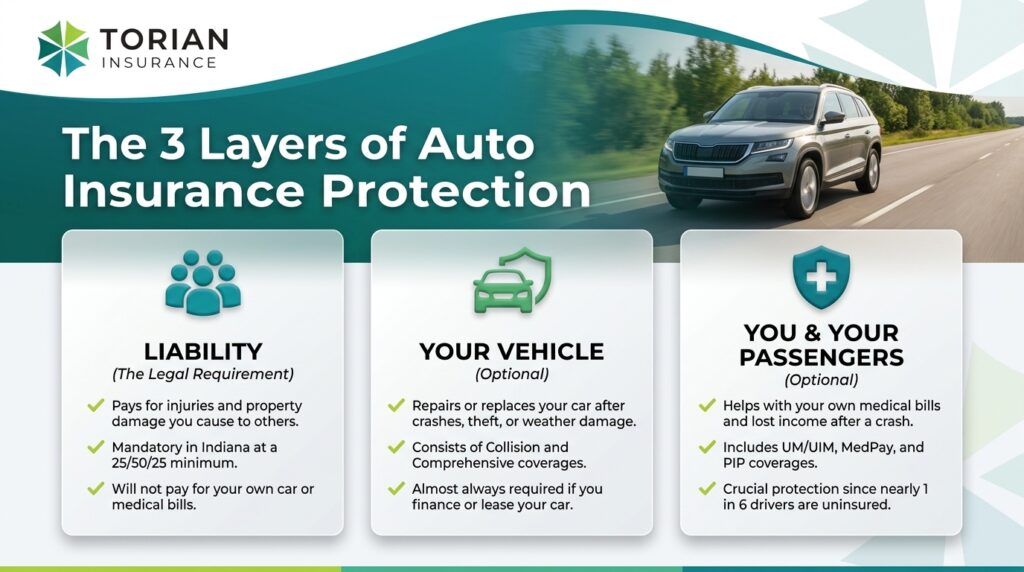
A car insurance policy is really a bundle of separate coverages, and each one does a specific job. The clearest way to understand any policy is to sort its parts into three groups based on who or what they protect.
Most of the confusion around auto insurance disappears once you can place each coverage into one of these three buckets:
- Coverage for other people: liability coverage pays for the injuries and property damage you cause to others when a crash is your fault.
- Coverage for you and your passengers: medical payments, personal injury protection, and uninsured/underinsured motorist coverage help with your own injuries and lost income.
- Coverage for your vehicle: collision and comprehensive coverage pay to repair or replace your own car.
Indiana law only requires the first bucket. Everything else is optional from a legal standpoint, which is exactly why understanding the types below matters.
Indiana’s Minimum Car Insurance Requirements
Indiana law requires every driver to carry at least 25/50/25 in liability coverage. That breaks down into three separate limits:
- $25,000 in bodily injury coverage for one person in an accident
- $50,000 in bodily injury coverage for all people in an accident
- $25,000 in property damage coverage per accident
These limits sit inside Indiana’s financial responsibility law (IC 9-25), and you must keep proof of coverage to drive legally.
Indiana operates on an at-fault, or tort, basis. The driver who causes a crash is responsible for the other party’s damages, and that driver’s liability coverage is what responds. If you are at fault and carry only the minimum, your coverage pays the other party up to those limits, and anything above them can come out of your own pocket.
The minimum is a legal floor, not a measure of whether you have enough coverage. A single newer vehicle can be worth far more than the $25,000 property damage limit, and serious injuries can move past the bodily injury limits quickly. Meeting the minimum keeps you road-legal. It does not guarantee that a bad accident won’t reach your savings.
The Core Types of Car Insurance Coverage
Beyond the legal minimum, a handful of coverages make up most real-world policies. Here is what each one does and when it earns its place on your policy.
Liability Coverage (Bodily Injury and Property Damage)
Liability coverage pays for the injuries and property damage you cause to other people when you’re at fault. It has two parts: bodily injury liability, which covers the other party’s medical costs, and property damage liability, which covers their vehicle or property. It does not pay for your own injuries or your own car. This is the coverage Indiana requires you to carry.
Collision Coverage
Collision coverage pays to repair or replace your vehicle after a collision with another car or an object, such as a guardrail or a pole, regardless of who caused it. It applies after you pay your deductible, the amount you cover before your insurer pays the rest. Collision is optional under Indiana law, but lenders usually require it on financed cars.
Comprehensive Coverage
Comprehensive coverage pays for damage to your vehicle from events other than a collision: theft, fire, hail, falling branches, vandalism, or hitting an animal. Collision and comprehensive are often bought together and are commonly confused, so for a full side-by-side look at the two, see our guide to comprehensive vs collision insurance.
Uninsured and Underinsured Motorist Coverage (UM/UIM)
Uninsured motorist (UM) coverage helps pay your costs when an at-fault driver has no insurance, including hit-and-run cases. Underinsured motorist (UIM) coverage helps when the at-fault driver has insurance, but their limits are too low to cover your losses. In Indiana, insurers must offer UM/UIM at limits equal to your liability limits unless you reject the coverage in writing (IC 27-7-5-2).
This coverage matters more than many drivers expect. About 15.4% of US drivers were uninsured in 2023, and roughly one in three were either uninsured or underinsured. If one of them hits you, UM/UIM is often what stands between you and an out-of-pocket loss.
Medical Payments and Personal Injury Protection
Medical payments coverage, often called MedPay, helps pay medical bills for you and your passengers after a crash, regardless of who’s at fault. Personal injury protection (PIP) is a broader version available in some markets that can also cover related costs like lost wages. Both are no-fault coverages, meaning they pay without first sorting out who caused the accident.

“Full Coverage” vs Liability-Only: What the Terms Really Mean
“Full coverage” is not an official policy type. The phrase usually means liability coverage combined with collision and comprehensive. Indiana only requires liability, so liability-only is the legal floor and full coverage is shorthand for a more complete package. Two policies both called full coverage can still look different depending on what you add.
| Liability-only | Full coverage | |
| What it includes | Bodily injury and property damage liability | Liability plus collision and comprehensive |
| Pays for your own car | No | Yes, after your deductible |
| Indiana legal status | Meets the legal minimum | Exceeds the minimum |
| Often a good fit for | Older, low-value cars you own outright | Newer or financed vehicles |
Liability-only can be a reasonable choice when your car’s value is low enough that the yearly cost of collision and comprehensive approaches what the car is worth. Full coverage makes more sense on a newer car, and your lender will usually require full coverage until a loan or lease is paid off. The deductible you choose also shapes the price, since a higher deductible lowers your premium but raises what you pay at claim time. For how that tradeoff works, see our explainer on how car insurance deductibles work.
Optional Coverages That Fill Specific Gaps
Once you move past the core coverages, several add-ons solve narrower problems. None are required in Indiana, but each addresses a real situation drivers run into.
- Gap insurance: covers the difference between what you owe on a loan or lease and your car’s actual cash value (ACV), its depreciated market value. Because most auto policies pay only the ACV on a totaled car, a loan can outlast the car’s worth. See whether gap insurance is worth it for your situation.
- Rental reimbursement: pays for a rental car while yours is being repaired after a covered claim.
- Roadside assistance: covers towing, jump-starts, flat tires, and lockouts.
- Personal umbrella coverage: adds a layer of liability limits above your auto and home policies for large claims. Note that personal umbrella coverage generally requires you to carry existing home and auto policies first.
What Car Insurance Does Not Cover
Even a full coverage policy has limits. Standard auto insurance excludes certain people, uses, and types of damage, and knowing the gaps up front prevents surprises at claim time.
- Routine maintenance and wear: oil changes, tires, brakes, and mechanical breakdown from normal use are the owner’s responsibility, not the insurer’s.
- Excluded or unlisted drivers: a driver you’ve specifically excluded, or a regular household driver you never added, may not be covered in a claim.
- Business use: using a personal vehicle for deliveries, rideshare, or other commercial work usually needs separate commercial coverage.
- Personal belongings: items stolen from inside your car are generally covered by home or renters insurance, not your auto policy.
- Intentional or illegal acts: damage you cause on purpose, or while racing or committing a crime, is excluded.
- Aftermarket modifications: custom parts and performance upgrades often need scheduled coverage to be paid at full value.
- Driving outside the coverage area: most US policies do not extend to international driving, such as trips into Mexico.
How to Choose the Right Amount of Car Insurance Coverage
Choosing coverage comes down to one question: how much financial risk can you absorb on your own? The legal minimum keeps you road-legal, but adequate coverage is about protecting your savings, your income, and your assets if a serious crash turns out to be your fault.
A few factors drive both your risk and your rate, and they’re worth reviewing whenever your situation changes:
- Your driving record: tickets and at-fault accidents raise rates; a clean record lowers them.
- Your vehicle: newer, higher-value, and costlier-to-repair cars generally cost more to insure.
- Where and how much you drive: location and annual mileage both affect pricing.
- Your limits and deductibles: higher limits raise the premium; higher deductibles lower it.
There are also ways to bring the cost down without dropping the coverage you need, from bundling policies to safe-driver and anti-theft discounts. Our guide to lowering your auto insurance costs walks through the most effective ones.
One piece of practical guidance from independent agents: many drivers carry liability limits well above the state minimum, often around 100/300/100, because the added cost is usually modest next to the extra coverage it buys. As national context, the average expense per insured vehicle was $1,281 in 2023. That figure is a national benchmark, not a quote, since what you actually pay depends on your own carrier, vehicle, and driving history.
How Torian Insurance Helps
As an independent insurance agency, we shop multiple carriers on your behalf rather than selling one company’s policies. That lets us compare options and match your car insurance coverage to your actual situation across Indiana, Kentucky, and Illinois. Founded in 1923, Torian Insurance is Evansville’s largest locally owned independent agency.
Because we’re independent, we can explain the tradeoffs in plain language: where to set your liability limits, whether full coverage still makes sense on an older vehicle, and how much UM/UIM coverage fits your risk. Our team brings more than 1,000 years of combined experience to those conversations, and we’d rather help you understand a policy than push you toward one.
“We just love working with Torian! Everyone is so wonderful and helpful. We have had excellent guidance, explanations, and recommendations for all of our insurance needs.”
Kimberly H.
You can read more client testimonials to see how that approach plays out for other local drivers and families.

Frequently Asked Questions About Car Insurance Coverage
What are the three main types of car insurance?
The three you’ll hear about most are liability, collision, and comprehensive. Liability covers damage you cause to others, collision covers your own car in an accident, and comprehensive covers non-collision damage like theft, hail, or hitting a deer. Indiana only requires liability.
What is considered full coverage car insurance?
Full coverage isn’t a specific policy you can buy by name. It generally refers to a policy that combines liability with collision and comprehensive coverage. Because the exact mix depends on what you add, two policies both described as full coverage can include different things.
What happens if I drive without insurance in Indiana?
Driving without the required coverage can lead to suspension of your driving privileges and reinstatement fees, and a requirement to file proof of future financial responsibility. Indiana requires at least 25/50/25 in liability coverage to drive legally.
Do I need full coverage on an older car?
Not always. If your car’s value is low, the yearly cost of collision and comprehensive can approach what the car is worth, so liability-only may be a reasonable choice. If you still owe money on the vehicle, your lender will likely require full coverage until the loan is paid off.
How much liability coverage should I carry?
Indiana’s minimum is 25/50/25, but many drivers carry higher limits such as 100/300/100 to better protect their assets, since the minimum’s $25,000 property damage limit can be used up by a single newer vehicle. The right amount depends on what you own and how much risk you’re comfortable carrying yourself.
Get Coverage That Fits, Not Just the Minimum
The right policy isn’t about buying the most coverage or the least. It’s about matching your coverage to your vehicle, your budget, and what you’d need if an accident were your fault. If you’re not sure whether your current policy still fits, the team at Torian Insurance can review your situation and walk you through the options at your own pace.