Renting your home to paying guests changes how it needs to be insured, and a lot of hosts find that out the hard way. Short-term rental insurance fills the gap between a standard homeowners policy and the coverage a working rental actually needs. This guide explains what that gap is, what Airbnb’s AirCover does and does not do, and how the options compare for hosts in Indiana and the tri-state.
Key Takeaways
- A standard homeowners policy generally excludes commercial activity, so renting your home to guests is usually not covered without separate or added coverage (Insurance Information Institute).
- Airbnb states that its AirCover for Hosts program is not a substitute for personal insurance, and Vrbo’s protection is liability only.
- Short-term rental insurance is built for properties rented to paying guests for short stays, generally up to about five months at a time.
- Telling your agent you rent the home is the single most important step. Hosts who do not disclose rental use risk denied claims, reduced coverage, or cancellation.
- Cost depends on property value, location and fire risk, your liability limits, and your deductible, so there is no single price that fits every host.
- If you own a second home you use personally and do not rent out, your coverage needs are different from a host’s.
What Is Short-Term Rental Insurance?
Short-term rental insurance is coverage designed for a home or unit you rent to paying guests for short stays. It protects the building, your belongings, and your liability in situations a personal homeowners policy was never written to handle, such as a guest injury or guest-caused damage.
In insurance terms, a short-term rental generally means guests stay briefly, often a week or two at a time and up to about five months. Once a tenant stays six months or longer, you are usually in landlord territory instead. Coverage can be added two ways: as an endorsement (also called a rider), which is an add-on that adjusts your existing policy for rental use, or as a separate standalone policy written specifically for the rental. Torian’s vacation rental property coverage is built for exactly this use.
You likely need short-term rental coverage if any of the following describe your situation:
- You rent out your whole home while you travel or during events.
- You rent a spare room, finished basement, or guest house to paying guests.
- You list a property on Airbnb, Vrbo, or a similar platform, even occasionally.
If you own a second home that you use personally and do not rent out, your needs are different. Our guide to insuring a vacation home you do not rent covers security, seasonal maintenance, and protecting valuables for that situation.
Does Homeowners Insurance Cover Airbnb or Vrbo Rentals?
No. A standard homeowners policy generally does not cover renting your home to guests. Homeowners insurance is written for personal, residential use, and taking payment to host guests is treated as commercial activity, which most policies exclude.
Many hosts hesitate to tell their insurer they rent, worried it will raise rates or cause problems. The bigger risk usually runs the other way. When an insurer is not aware of the rental use, a claim tied to that activity may be handled differently:
- The claim can be denied.
- Liability coverage can be reduced.
- The deductible can be higher.
- The policy can be cancelled.
None of this is meant as a warning. It is simply why a quick conversation with your agent matters, because disclosing the rental is what keeps your coverage intact.
This is why a standard home insurance policy and a rental setup do not mix on their own. The fix is usually a rental endorsement or a dedicated short-term rental policy, not hiding the activity and hoping a claim never comes.

Standard Homeowners vs. AirCover vs. Short-Term Rental Insurance
These three are not interchangeable. A standard homeowners policy covers personal use. A platform program like AirCover adds a limited safety net while you host. Short-term rental insurance is the only one of the three built specifically for renting to guests. Here is how they compare:
| Coverage option | What it handles well | Where it falls short for hosts |
| Standard homeowners insurance | Personal, owner-occupied living and your own use of the home | Excludes commercial and rental activity, so guest injury and guest-caused damage from renting are typically not covered. |
| Airbnb AirCover and platform protection | A built-in safety net while you actively host a stay on the platform | Not a substitute for personal insurance. Gaps include time between stays, off-platform bookings, and certain types of damage. |
| Short-term rental insurance | A home rented to paying guests: building, contents, lost rental income, and host liability | Built for the use, so few gaps for hosting itself. Premium varies by property and how you rent. |
Does Airbnb’s AirCover Replace My Insurance?
No. Airbnb itself states that AirCover for Hosts is not a substitute for personal insurance. It is a platform program that adds a layer of protection while you host, not a policy you own or control. AirCover for Hosts includes host liability insurance and a separate host damage protection program, with the specific limits set by Airbnb.
What AirCover does not do is just as important for hosts to understand. It generally will not help with:
- The periods when you are not actively hosting a guest, such as between bookings.
- Bookings that are made and paid for off the platform.
- Ordinary wear and tear or maintenance issues.
- Replacing the building, contents, and liability coverage that a real policy provides.
How Airbnb and Vrbo Host Coverage Differ
The biggest difference between the two platforms is property damage. Both describe similar liability coverage, but Airbnb also protects your own property against guest-caused damage, while Vrbo’s program is liability only and does not cover your property. That distinction is easy to miss and important to plan around.
| Feature | Airbnb (AirCover for Hosts) | Vrbo |
| Liability coverage | About $1 million per occurrence | About $1 million |
| Damage to your own property | Up to $3 million in host damage protection for guest-caused damage; wear and tear and acts of nature are excluded | Not covered for the host’s own property |
| What it means for you | A meaningful safety net, but not a replacement for your own policy | Strong on liability; your building and contents still need separate coverage |
Platform programs change, so confirm the current figures on each platform before you rely on them.
Short-Term Rental Insurance vs. Landlord Insurance
These cover two different rental models. Short-term rental insurance is for properties rented to guests for short stays, while landlord insurance is for properties leased to long-term tenants, generally six months or longer. The line usually falls around that five-to-six-month mark.
The practical differences come down to turnover and use:
- Short-term rental insurance: guests stay days to a few months, turnover is high, and coverage focuses on guest injury, guest-caused damage, and lost rental income.
- Landlord insurance: one tenant holds a lease for six months or more, occupancy is stable, and coverage centers on the structure, liability, and lost rent.
If you rent the same property to long-term tenants, landlord insurance is the better fit. And if you run your rental as a business or under an LLC, you may also want business liability insurance to protect the operation itself.
Who Is Responsible When a Guest Is Hurt at Your Rental?
Liability usually comes down to a principle called duty of care. Host liability is your legal responsibility for harm to guests on your property. As the host, you are generally responsible for injuries caused by something you should have maintained, while guests are generally responsible for injuries caused by their own carelessness.
In practice, that responsibility tends to split like this:
- The host is generally responsible for: maintenance failures such as a loose stair railing, a broken step, or faulty wiring, and unsafe conditions you knew about or should have known about.
- The guest is generally responsible for: their own negligent acts, such as ignoring posted safety rules or injuring themselves through carelessness.
This is why your liability limits matter so much. A serious guest injury claim can reach well beyond what a platform program covers, and a dedicated policy is what stands between that claim and your personal finances.
How Much Does Short-Term Rental Insurance Cost?
There is no single price for short-term rental insurance, because it is priced on your specific property and how you rent it. As an independent agency, Torian shops multiple carriers to match your situation rather than quoting one fixed rate. A handful of factors drive what you pay:
- Property value and rebuild cost: a higher-value home costs more to insure because there is more to replace.
- Location and risk profile: fire risk, flood exposure, and local crime all factor into the premium.
- Liability limits: higher limits raise the premium but protect you against larger claims.
- Deductible: a higher deductible lowers your premium but raises what you pay out of pocket at claim time.
- How often you rent: a full-time rental carries more exposure than an occasional weekend listing.
For most hosts, the value question answers itself. A single uncovered guest injury or a major guest-caused loss can cost far more than years of premium, and proper coverage lets you keep accepting bookings without carrying that risk personally.
Short-Term Rental Rules to Know in Indiana and the Tri-State
Insurance is only part of running a short-term rental legally. Indiana, Kentucky, and Illinois leave most short-term rental rules to cities and counties, so requirements vary by where your property sits. Indiana addresses short-term rentals in state law, which lets local governments require permits and apply zoning while limiting outright bans (Indiana Code 36-1-24).
Because the details live at the local level, plan to check on a few things before you list:
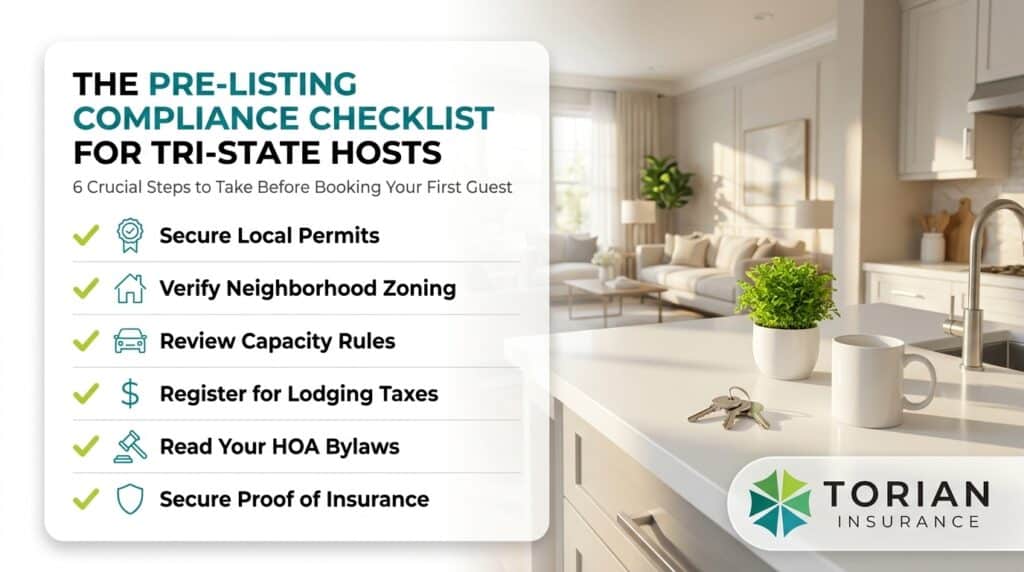
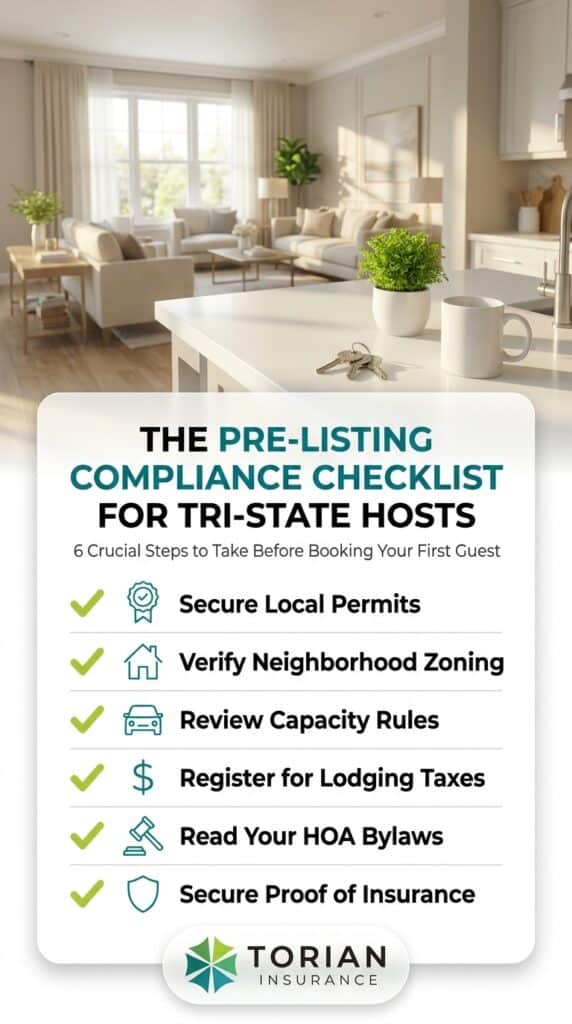
- A short-term rental permit or registration, which many Indiana cities and counties require.
- Zoning approval or a special exception, especially in residential neighborhoods.
- Occupancy and parking limits set by the local ordinance.
- Local lodging or innkeeper’s tax, which usually applies even where short-term rentals are allowed.
If your property is a condo or sits in an HOA, the association can add its own restrictions, and one owner’s rental activity can affect the building’s shared insurance. Check your bylaws before you book a guest. Whatever the local rules, notify your insurer, because permit applications and platform listings often ask for proof of coverage.
How Torian Insurance Helps
As an independent insurance agency founded in 1923, Torian Insurance has spent more than a century helping families and businesses across Evansville and the tri-state protect what they own. We are Evansville’s largest locally owned independent agency, and we are licensed in Indiana, Kentucky, and Illinois.
Because we are an independent agency, we do not underwrite policies ourselves. We shop multiple carriers on your behalf to find short-term rental coverage that fits how you actually use your property. Whether you are turning a spare room into a listing, running a full-time rental, or somewhere in between, we will review your current homeowners policy, point out the gaps, and explain your options in plain language.
Our clients tell us the value shows up both when they need guidance and when they need to file a claim. You can read more in our client testimonials:
Frequently Asked Questions About Short-Term Rental Insurance
Is short-term rental insurance required?
No single law requires every host to carry it, but several parties often do. Airbnb and Vrbo, local permit processes, mortgage lenders, and HOAs may all ask for proof of coverage, and your own homeowners policy will not protect rental activity. In practice, most hosts need it to operate without exposing themselves to large uncovered losses.
Will my insurer drop me if I rent my home on Airbnb?
Renting your home does not automatically cancel your policy, but failing to disclose it can. Telling your agent lets them adjust your coverage or add an endorsement so your policy stays valid. The risk comes from hiding the rental, which can lead to a denied claim or cancellation, not from hosting itself.
What does Airbnb’s AirCover not cover?
AirCover is not a substitute for personal insurance, and it has clear limits. It generally does not cover intentional damage, ordinary wear and tear, the periods when you are not actively hosting, or bookings made off the platform. For full protection of your building, contents, and liability, you need your own policy.
Do I need short-term rental insurance if I only rent a few weekends a year?
Yes. Even occasional hosting counts as commercial use, and a guest injury or guest-caused loss on a single weekend can trigger the same coverage gap as a full-time rental. Renting part of the year does not make a standard homeowners policy cover the activity.

Talk to a Local Agent About Your Rental
Every short-term rental is a little different, and so is the coverage it needs. If you are not sure whether your current policy protects your rental activity, the team at Torian Insurance can review your situation and walk you through the options. Contact Torian Insurance to talk with a local agent about short-term rental coverage.