

If your business carries general liability and commercial auto coverage, you already have a layer of protection. But every one of those policies has a ceiling. Commercial umbrella insurance is the coverage that takes over once those primary limits run out, and for many Indiana business owners it is the difference between a manageable claim and one that threatens the whole operation.
Key Takeaways
Here is what every business owner should understand about commercial umbrella coverage before deciding on a limit:
- Commercial umbrella insurance adds liability coverage above the limits of your primary policies, such as general liability, commercial auto, and employers liability. It begins paying once an underlying limit is used up.
- A commercial umbrella is broader than excess liability. An umbrella can add limits, drop down to cover some claims the underlying policy does not, and provide wider protection, while excess liability simply adds limits and follows the underlying policy’s terms.
- Commercial umbrella coverage does not replace workers’ compensation or professional liability. It generally will not cover employee injuries, professional errors, or your own business property.
- A commercial umbrella is rarely required by law, but contracts, leases, and larger clients often require one. Construction and transportation work commonly trigger umbrella requirements.
- Cost depends on your underlying limits, industry, and risk profile, not a flat rate. The right limit is sized to what your business stands to lose, not a default number.
What Is Commercial Umbrella Insurance?
Commercial umbrella insurance is a layer of liability coverage that sits above your primary business policies. When a covered claim exhausts the limit on an underlying policy like general liability or commercial auto, the umbrella extends protection beyond that ceiling, up to the umbrella’s own limit. The whole point of the coverage is to add liability protection past the point where a business has used up its primary limits.
Two terms make the rest of this easier to follow:
- Underlying policy (or primary policy): the first-layer coverage the umbrella sits above, such as your general liability or commercial auto policy.
- Aggregate limit: the most a policy will pay across the whole policy term, no matter how many separate claims arise.
Each primary policy has a per-occurrence limit and often an aggregate limit. When a large claim, or a string of smaller claims, uses up that limit, anything above it would normally come out of the business’s own pocket. A commercial umbrella covers that gap.
This is a business policy, and it is distinct from a personal umbrella that protects your household assets. If you are researching coverage for your family rather than your company, the personal version is covered in our guide to personal asset protection and umbrella coverage.
Commercial Umbrella vs. General Liability: How the Layers Work Together
Commercial umbrella insurance and general liability insurance are not competing products. General liability is a primary policy that covers third-party bodily injury and property damage claims up to its limit. A commercial umbrella sits on top of that policy and extends the limit when a claim runs past it.
Think of it as two layers working together. Your general liability insurance responds first. If a covered claim is larger than that policy can pay, the umbrella picks up the remainder, up to its own limit.
Here is a practical example. Say a customer is seriously injured at your business and the claim settles for $1.4 million, while your general liability policy carries a $1 million per-occurrence limit. The primary policy pays its $1 million, and a commercial umbrella would cover the remaining $400,000 that would otherwise fall on the business. For more on that primary layer, our post on why general liability is the backbone of a business walks through what it does and does not cover.

What Is the Difference Between Umbrella and Excess Liability Insurance?
The difference comes down to how much each one does. Excess liability adds limits on top of an underlying policy and follows that policy’s terms. A commercial umbrella also adds limits, but it can additionally cover some claims the underlying policy excludes and provide broader protection.
In risk-management terms, a commercial umbrella can do three things: it provides excess limits once the underlying limits are exhausted, it can drop down to pick up certain claims the underlying policy does not cover, and it can offer broader protection than the policy beneath it. Excess liability is narrower. It adds limits and otherwise mirrors the underlying coverage.
Two terms help here. Follow form means a policy adopts the same terms, conditions, and exclusions as the policy beneath it. Drop down means the coverage steps in to fill a gap the underlying policy leaves open. Excess liability follows form. An umbrella can sometimes drop down.
This comparison shows how the three coverages line up:
| Feature | General Liability | Excess Liability | Commercial Umbrella |
| Role | Primary (first-layer) policy | Adds limits only | Adds limits plus broader coverage |
| What it does | Covers third-party injury and property claims up to its limit | Extends the limit of one underlying policy | Extends limits across several underlying policies |
| Follows the underlying policy terms | It is the underlying policy | Yes, it follows form | Usually, but can be broader or drop down |
| Can cover claims the primary excludes | No | No | Sometimes, subject to a self-insured retention (an amount the business pays first) |
| Typical use | Baseline liability protection | A higher limit on a single policy | Catastrophic protection across the business |
What Does a Commercial Umbrella Policy Cover (and Exclude)?
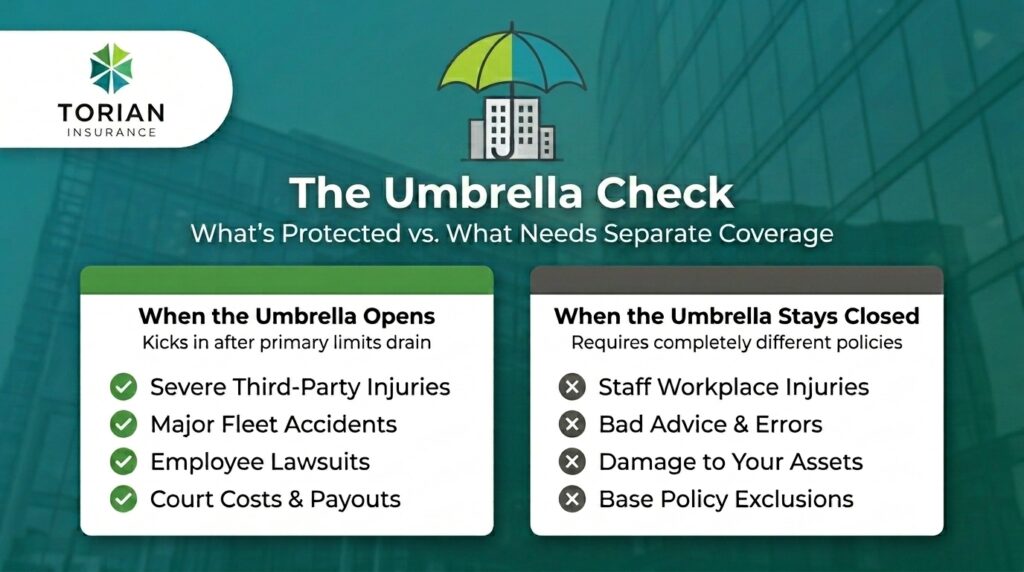
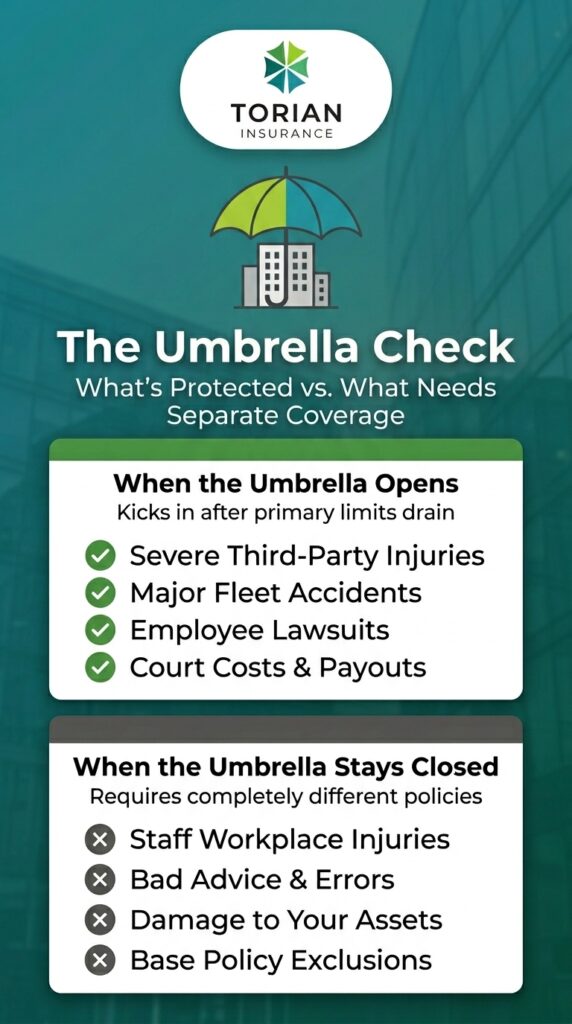
A commercial umbrella covers liability claims that exceed your primary policy limits, including legal defense costs, settlements, and judgments tied to covered events. It does not cover everything, and it generally follows the terms of the policies beneath it.
A commercial umbrella typically extends over claims like these once the underlying limit is used up:
- Excess bodily injury and property damage: above your general liability limit.
- Excess auto liability: above your commercial auto limit after a serious accident.
- Excess employers liability: above the employers liability portion of your coverage.
- Legal defense and settlement costs: above the limits of the underlying policy.
Just as important is what a commercial umbrella does not do. It is not a catch-all, and these exposures need their own coverage:
- Employee injuries: these are handled by workers’ compensation, not a commercial umbrella.
- Professional mistakes: a commercial umbrella does not cover professional errors or omissions, which is the job of professional liability (E&O) insurance.
- Your own business property: damage to your buildings, equipment, or inventory is a commercial property matter, not a liability one.
- Claims the underlying policy already excludes: because the umbrella generally follows the policy beneath it.
Exclusions vary from one policy to the next, so the practical step is to review your specific policy with your agent rather than assume the umbrella fills every gap.
Does My Business Need Commercial Umbrella Insurance?
Your business likely benefits from a commercial umbrella if it has assets to protect and real exposure to large liability claims. That usually means vehicles on the road, employees, a location customers visit, or contracts that require higher limits. If you are still assembling your baseline coverage, our overview of business insurance for Indiana companies is a good starting point before you add an umbrella on top.
Is a commercial umbrella mandatory? Generally, no. There is no broad legal requirement to carry one. The pressure to add umbrella coverage usually comes from contracts, leases, lenders, or larger clients who set a minimum limit before they will work with you.
For Indiana and tri-state businesses, the need tends to show up in specific situations:
- Contractors and construction: a general contractor or project owner may require a $1 million to $5 million umbrella before work begins, and a single jobsite injury or property-damage claim can run past a standard general liability limit.
- Trucking and transportation: commercial auto limits can be exhausted quickly in a serious highway accident, especially one involving multiple vehicles, so an umbrella above the auto policy matters here.
- Businesses with foot traffic: retail shops, restaurants, and event venues see steady public contact, and a serious customer injury can produce a claim larger than a standard liability limit.
- Companies with employees and managers: day-to-day operations and supervision create liability exposure that can climb above primary limits.
The common thread is exposure. The more a single event could cost your business, the more an umbrella earns its place.
How Much Does Commercial Umbrella Insurance Cost?
There is no flat price for commercial umbrella insurance. Cost depends on the size of your underlying limits, your industry and its risk profile, your claims history, and how much umbrella coverage you carry. A higher-risk operation with vehicles and employees will generally pay more than a low-risk professional office.
A few factors do most of the work in shaping both your premium and the limit you should carry:
- Underlying limits and policies: the more primary coverage the umbrella sits above, and the more policies it has to back up, the more it generally costs.
- Industry and risk: higher-hazard work, such as construction or transportation, carries more exposure and tends to cost more to cover.
- Claims history: a record of past claims can affect how a carrier prices the coverage.
- Limit selected: a $5 million umbrella costs more than a $1 million umbrella, so the right number is the one that matches your actual exposure.
Rather than chasing the lowest premium, the better question is whether the limit is sized correctly. Set it too low and a large claim still reaches the business. An independent agent can compare options across multiple carriers to match the limit to your risk at a competitive rate.

How Torian Insurance Helps
As an independent insurance agency, we are not tied to one carrier. We shop coverage across multiple carriers and match the umbrella limit to your actual exposure rather than a default number. Founded in 1923, Torian Insurance is Evansville’s largest locally owned independent agency, licensed in Indiana, Kentucky, and Illinois.
Right-sizing a commercial umbrella means looking at the whole picture: your underlying general liability, commercial auto, and employers liability limits, the contracts you sign, and the realistic worst case for your industry. We help business owners across the Evansville and tri-state area review those layers, spot the gaps, and choose a limit that fits the way they actually operate.
Frequently Asked Questions About Commercial Umbrella Insurance
Does commercial umbrella insurance cover professional liability?
No. A commercial umbrella does not cover professional errors or omissions. That exposure is handled by professional liability, also called errors and omissions (E&O) coverage. An umbrella extends the limits of policies like general liability and commercial auto, not professional services claims.
Is commercial umbrella insurance required by law?
Generally, no. Indiana does not require businesses to carry a commercial umbrella. When a business does need one, the requirement usually comes from a contract, lease, lender, or larger client that sets a minimum coverage limit as a condition of doing business.
Can a client or landlord require my business to carry umbrella coverage?
Yes. Many commercial contracts, leases, and vendor agreements set a minimum umbrella limit, often $1 million or higher, before they will let you sign on or start work. It is common in construction, transportation, and any arrangement where one party wants assurance the other can cover a large claim.
Does a commercial umbrella include my company vehicles?
It can extend coverage above your commercial auto policy, but it is not a substitute for that policy. The umbrella pays after the commercial auto limit is exhausted, so you still need the underlying auto coverage in place for the umbrella to sit above.
Protecting What You’ve Built
A commercial umbrella is not about expecting the worst. It is about making sure that one large claim does not undo years of work. The right limit turns a potentially business-ending event into a covered one.
If you are not sure whether your current limits are enough, the team at Torian Insurance can review your coverage and help you find the right commercial umbrella insurance for your business. Contact Torian Insurance to talk with a local agent who knows the tri-state area.