

When one person holds the relationships, the revenue, or the license that keeps a company running, their sudden loss is not only personal. It is a financial event. Key person insurance is how a business protects itself against that event, and for many small companies across Indiana, Kentucky, and Illinois, it can be the difference between a hard season and a closed door.
Key Takeaways
- Key person insurance is a life or disability policy a business buys on an owner or essential employee, with the business as both the policy owner and the beneficiary.
- The clearest reasons to buy are when one person drives a large share of revenue, holds critical relationships or a required license, or a lender or investor requires coverage as a condition of a loan.
- Businesses size coverage using a multiple of the person’s compensation, the profit tied to that person, or the cost to replace them plus any loan the payout must retire.
- Premiums are generally not tax deductible because the business is the beneficiary, under IRC Section 264(a)(1).
- The death benefit is generally income-tax-free only if the business completed the written notice-and-consent steps under IRC Section 101(j) before the policy was issued and reports the coverage on IRS Form 8925.
- Key person insurance pays the business, not the insured’s family, which sets it apart from personal and group life insurance.
What Is Key Person Insurance?
Key person insurance, sometimes called key man insurance, is a policy a business takes out on an owner or employee whose loss would seriously hurt the company. The business owns the policy, pays the premiums, and is the beneficiary, so any payout goes to the business. It exists to keep the business stable if that person is suddenly gone.
The coverage can be written two ways:
- Life insurance: pays a death benefit to the business if the key person dies.
- Disability coverage: pays the business if a long-term disability keeps the key person from working.
This is different from a personal policy or an employee benefit like group life insurance, where the payout goes to the individual’s family. With key person coverage, the company is the beneficiary, so the money replaces lost income, pays down debt, or funds a replacement.
Does Your Business Need Key Person Insurance? Five Signals to Watch For
You likely need key person insurance when the business depends heavily on one person and could not absorb their sudden loss without financial strain. Small businesses make up 99.9 percent of U.S. companies, and in a small company a large share of revenue, relationships, or know-how often sits with one or two people.
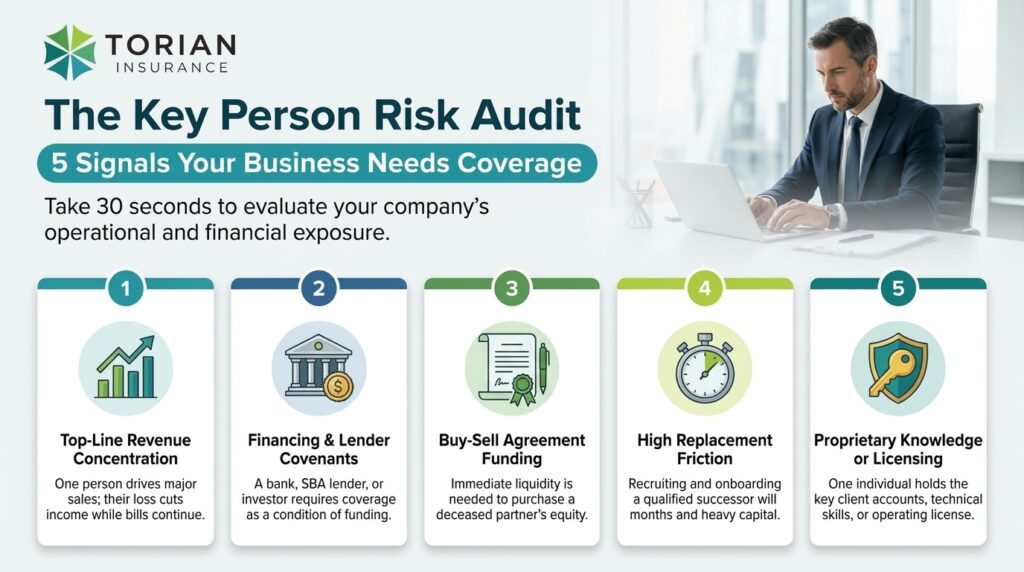
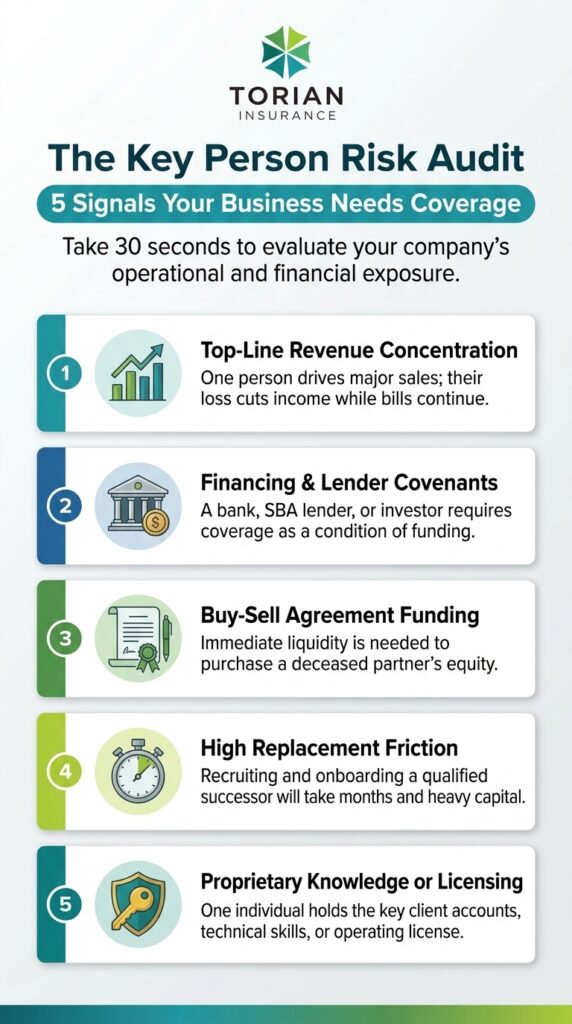
If two or more of these describe your business, coverage is worth pricing:
- Revenue concentration: one person drives a large share of revenue or profit, so their sudden absence would cut income while fixed costs keep running.
- A lender or investor requirement: loan covenants and investors often require coverage on a founder or principal.
- A buyout triggered by a death: an owner or partner’s death would trigger a buyout, so pairing coverage with a buy-sell agreement makes funds available to buy the share.
- A hard-to-replace role: replacing the person would take months and money, and coverage can fund recruiting, training, and lost productivity during the gap.
- Concentrated relationships or know-how: one person holds the client relationships, a required license, or the specialized knowledge the business runs on.
Among establishments born in 2022, 77.3 percent survived their first year in the division covering Indiana and Illinois, and 77.6 percent survived in the division covering Kentucky. Key person coverage does not change those odds, but it keeps the loss of one person from becoming the reason a business does not recover.
Who Counts as a Key Person?
A key person is anyone whose knowledge, relationships, or output the business could not quickly replace. For one narrow tax rule, the Internal Revenue Code defines a key person as an officer or a 20-percent owner. That definition was written for a specific tax provision, so treat it as a reference point, not the only description of who matters.
In practice, a key person is often one of these:
- A founder or owner whose decisions and vision drive the business day to day.
- A top salesperson or rainmaker who controls the largest client accounts and relationships.
- An employee who holds a professional license or certification the business needs in order to operate.
- A specialist whose technical knowledge or processes would be difficult to document and hand off to someone new.
Who Owns the Policy, and Does the Insured Have to Consent?
The business owns the key person policy, pays the premiums, and is the beneficiary, so the payout goes to the company. The insured person also has to agree: under federal rules for employer-owned life insurance, the employee must give written consent before the policy is issued, and this step is easy to overlook.
That written notice-and-consent requirement comes from IRC Section 101(j), and it is not just paperwork. It is tied to whether the death benefit is received income-tax-free. Skip it, or complete it after the policy is issued, and part of the payout can become taxable.
How Much Key Person Insurance Does a Business Need?
There is no single formula. The right amount reflects what the business would lose if the person were gone and what it would take to recover, not a round number. Businesses work from one of three methods, each estimating that loss a different way.
How each method works:
- Compensation multiple: a multiple of the person’s salary or total compensation, which gives a simple starting point.
- Contribution to profit: an estimate of the revenue or profit tied to the person and the time the business would need to recover it.
- Replacement and obligation cost: the cost to recruit and train a replacement, plus any loan balance the coverage needs to retire.

Is Key Person Insurance Tax Deductible, and Is the Payout Taxed?
Key person insurance premiums are generally not tax deductible, because the business is the beneficiary of the policy. The death benefit is generally received income-tax-free, but only when the business follows specific federal rules first. Tax treatment turns on the details, so treat this as general information and confirm your situation with a tax professional.
Two rules drive the tax treatment:
- Premiums: the tax code does not allow a deduction for premiums on a life insurance policy when the taxpayer is directly or indirectly a beneficiary. Because the business is the beneficiary of a key person policy, those premiums generally are not deductible.
- The payout: the death benefit is usually income-tax-free only if the business completed the written notice-and-consent steps and reports the coverage on IRS Form 8925, as required under IRC Section 101(j). Miss those steps, and part of the payout can become taxable.
Torian provides insurance guidance, not tax or legal advice. Rules change and every business is structured differently, so confirm the tax treatment of any policy with a qualified tax professional.
What Affects the Cost of Key Person Insurance?
Key person insurance is priced like any life or disability policy, with a few factors tied to the business. Premiums vary by person and policy, so exact prices are not listed here, but these are the main drivers:
- The insured person’s age and overall health.
- The type of policy chosen, such as term life, permanent life, or disability coverage, and its length.
- The coverage amount the business decides on.
- The person’s role and how much risk the business carries if they are lost.
- Whether the policy adds riders or is bundled with other business coverage.
Key Person Insurance vs. Buy-Sell Agreements and Business Continuation Coverage
Key person insurance, buy-sell agreements, and business continuation coverage all protect a company from losing the people it depends on, but they solve different problems. Key person insurance replaces lost value when an essential person is gone, a buy-sell agreement funds the transfer of an owner’s share, and business continuation coverage is the broader category that includes both.
Here is how they compare:
- Key person insurance insures an essential owner or employee, and the payout helps the business stay stable, cover debt, or hire a replacement.
- Buy-sell agreements fund the buyout of a departing owner’s share, so ownership transfers smoothly if an owner dies or leaves.
- Business continuation coverage is the broader category that key person and buy-sell coverage both fall under, protecting a company through an owner or key employee’s death or disability.
For a closer look, the overview of the two main types of business continuation insurance walks through key person and buy-sell coverage side by side.
How Torian Insurance Helps Tri-State Businesses
At Torian Insurance, we have helped local businesses protect what they have built since 1923. As an independent agency, we are not tied to a single carrier, so we shop coverage across multiple companies to fit a policy to your business, from insuring one founder to a plan that ties key person and buy-sell coverage together. Key person insurance is often one part of a broader business insurance program, so we look at how it fits with the rest of your coverage.
We are Evansville’s largest locally owned independent insurance agency, and we work with owners across Indiana, Kentucky, and Illinois. Because we are local, we can sit down with you, learn how your business actually runs, and build coverage around the people it depends on. You can meet the people you will work with on our team or read more about our history and approach.
The right structure depends on your business, so if you want to talk it through, our team is happy to answer your questions and help you weigh your options.

Frequently Asked Questions About Key Person Insurance
Is key person insurance the same as key man insurance?
Yes. Key man insurance is an older name for key person insurance. Both describe a policy a business owns on an essential person, with the business as the beneficiary, and you will see the terms used interchangeably.
Who receives the payout from a key person policy?
The business receives the payout, not the insured person’s family. That is the main difference between key person coverage and personal or group life insurance. The company uses the money to cover lost income, pay debts, or fund a replacement.
Can key person insurance cover disability, not just death?
Yes. Key person coverage can be written as life insurance that pays if the person dies, or as disability coverage that pays if a long-term disability keeps them from working. A disabling injury can disrupt a business as much as a death, so both are worth weighing.
When should a small business get key person insurance?
The best time is before you need it, when the business first becomes dependent on one person or a lender or investor asks for coverage. If losing a single owner or employee would put revenue, a loan, or daily operations at risk, it is worth pricing coverage now rather than after a change.
Protect the People Your Business Depends On
Every business has at least one person it cannot easily replace. Key person insurance turns that risk into a plan, so a sudden loss is something the company can absorb, not a threat to its future.
If you are weighing coverage, learn more about key person insurance with Torian and talk with a local agent who can review your situation and help you find the right fit.