

If you’re running a small business in Indiana, you’ve probably asked the question: “What insurance do I actually need?”
The honest answer? It depends on your entity type, your industry, who you work with, and what milestones your business has reached. The “requirements” you face aren’t just about what Indiana law mandates—they’re about what you need to get paid, sign leases, win contracts, and keep your organization funded.
This guide is a real-world field manual for Indiana LLCs, contractors, and nonprofits. We’ll cover what’s legally required, what clients and landlords commonly demand, and what best practices protect your business from risks that catch owners off guard.
Quick Disclaimer (and Why “Requirements” Is Complicated)
Legal vs. Contractual vs. Best Practice
When someone says insurance is “required,” they could mean three very different things:
- Legal requirements: Coverages that Indiana or federal law mandates for certain businesses.
- Contractual requirements: The insurance a general contractor, landlord, or client demands before they’ll work with you.
- Best practices: Coverages that aren’t technically mandated by anyone but protect you from the financial fallout that puts small businesses under.
All three matter. A contractual requirement can be just as binding as a legal one if failing to meet it means you lose a six-figure contract or your commercial lease.
How Indiana, Your Entity Type, and Your Operations Change the Answer
Indiana has its own workers’ compensation statutes, bonding requirements, and vehicle insurance mandates. But beyond state law, your entity type and day-to-day operations shape the coverage you’ll need. A single-member LLC working from home faces a very different insurance picture than a general contractor with ten employees on a job site.
The 4 Buckets of “Insurance Requirements” in Indiana
It helps to think about insurance requirements as falling into four distinct buckets. Each can trigger coverage needs just as urgent as the others.
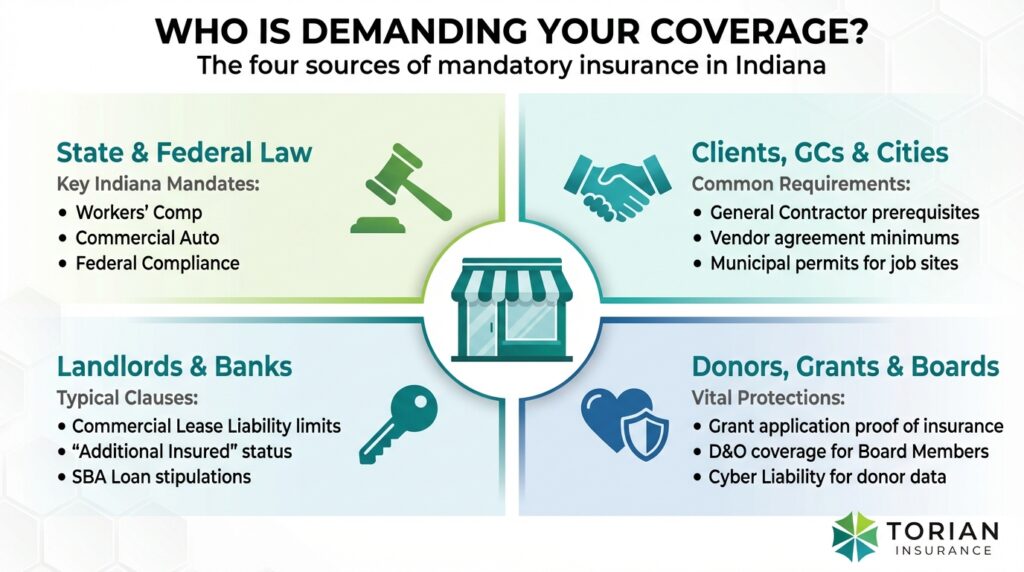
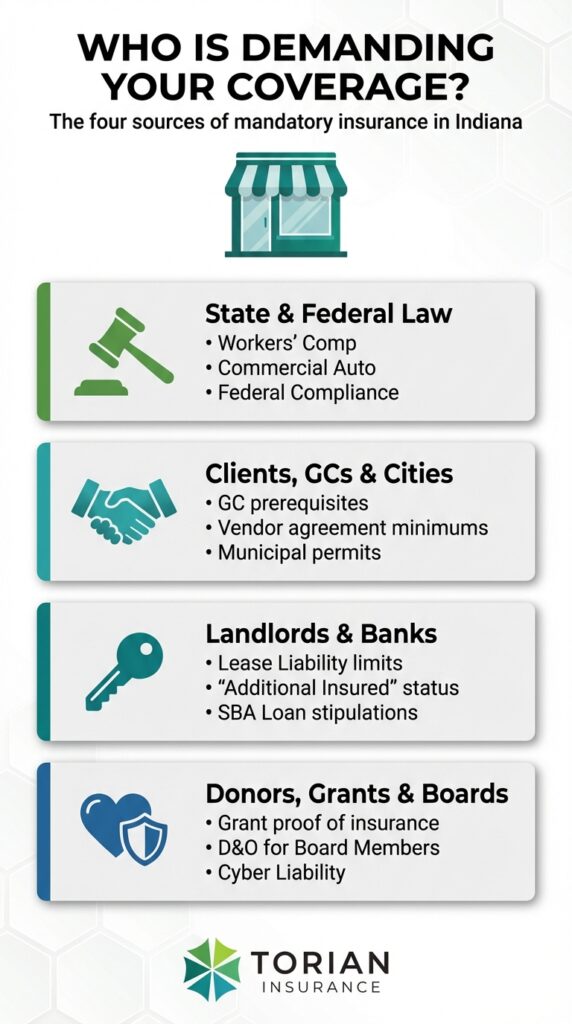
1) Legally Required (State/Federal)
These are the non-negotiable coverages. In Indiana, the most common legally mandated insurance requirements for small businesses include:
- Workers’ compensation: Under Indiana Code 22-3-2-2, virtually every employer with one or more employees must carry workers’ comp. There is no minimum employee threshold—if you have even one W-2 employee, you need a policy.
- Commercial auto: Indiana requires commercial auto insurance if your business owns or operates vehicles.
- Federal mandates: Depending on your industry, federal law may require additional coverages. For example, businesses with company-sponsored health plans must comply with ERISA.
2) Required by Clients, Contracts, and Municipalities
This is the bucket that surprises most business owners. Common sources of contractual insurance requirements include:
- General contractors routinely require subcontractors to carry general liability, workers’ comp, and commercial auto coverage before stepping foot on a job site.
- Municipalities may require proof of insurance before issuing permits.
- Corporate clients often include minimum coverage thresholds in their vendor agreements.
If you can’t produce a Certificate of Insurance (COI) that meets the contract terms, you don’t get the work—regardless of what Indiana law says.
3) Required by Landlords and Lenders
Signing a commercial lease in Indiana almost always involves an insurance requirement. Landlords typically require general liability coverage and often ask to be named as an additional insured. If you’re financing equipment or taking out an SBA loan, your lender will likely require proof that the financed assets are insured. These aren’t optional requests—they’re written into the agreements you sign.
4) Required by Grantors, Donors, and Board Governance
For Indiana nonprofits, insurance requirements often come from funding sources. Grant applications frequently ask for proof of general liability, D&O coverage, and sometimes cyber liability insurance. Missing this coverage can disqualify you from grants, spook donors, and leave board members personally exposed.
Indiana Baseline: Triggers Business Owners Miss
Some insurance triggers are obvious. Others are easy to overlook until you’re facing a penalty, a denied claim, or a lost contract.
Employees and Worker Status
Indiana requires workers’ compensation coverage from the moment you hire your first employee. Key details business owners need to know:
- Coverage applies to full-time, part-time, and seasonal workers.
- Business owners (other than sole proprietors and partners) are generally required to include themselves under the policy.
- Misclassifying employees as independent contractors to avoid workers’ comp obligations can lead to fines, back premiums, and personal liability.
- Both the Indiana Workers’ Compensation Board and the IRS scrutinize worker classifications.
Business Vehicles
If any vehicle is titled to your business, used primarily for business purposes, or driven by employees for work tasks, you need commercial auto insurance. Your personal auto policy will not cover accidents during business use—one of the most common coverage gaps for Indiana small businesses.
Commercial Leases and Public Exposure
The moment you sign a commercial lease or open your doors to the public, your liability exposure increases. Landlords expect tenants to carry general liability coverage, and most lease agreements spell out specific minimum limits. Even shared workspace or co-working agreements likely include an insurance clause.
Handling Sensitive Data
If your business collects customer information—credit card numbers, health records, Social Security numbers, or even email addresses—you have a data protection responsibility. Indiana’s data breach notification law (IC 24-4.9) requires businesses to notify affected individuals after a breach. Cyber liability insurance helps cover notification costs, legal defense, credit monitoring, and regulatory fines.
Indiana LLCs — Requirements by Operational Milestone
An LLC’s insurance needs evolve as the business grows. Here’s how to think about coverage at each stage.
Single-Member LLC, No Employees
If you’re a solo operator with no employees, Indiana law doesn’t require you to carry workers’ compensation or general liability insurance. However, “not legally required” and “not needed” are two very different things. Most single-member LLCs discover they need insurance the first time a client, landlord, or vendor asks for proof of coverage.
COI Requests for Leases
When you sign a commercial lease, your landlord will almost certainly ask for a Certificate of Insurance showing general liability coverage, typically with $1 million per occurrence and $2 million aggregate limits. Many landlords also require their property management company be listed as an additional insured. Without this documentation, you won’t get the keys.
Client Contract Language (Additional Insureds)
Clients—especially larger companies—often include insurance clauses in their service agreements requiring you to carry general liability, professional liability, or both, and to name the client as an additional insured. This extends a layer of protection to the client for claims arising from your work. It’s standard practice, and your agent can issue the endorsement quickly.
Hiring Your First Employee
The moment you bring on a W-2 employee, your insurance obligations change significantly. Indiana law requires workers’ compensation coverage for all employees from day one—no waiting period, no minimum employee count. Sole proprietors and partners may elect to exclude themselves, but LLC members who perform services for the business should generally be covered. Failing to carry workers’ comp is a Class A infraction and exposes you to personal liability for any workplace injury.
Professional vs. Physical Work
The type of work your LLC performs determines which additional coverages you’ll need. If your LLC provides advice, designs, consulting, technology services, or any work product where an error could cause a client financial harm, you should carry professional liability insurance (also called errors and omissions, or E&O). Many clients require it by contract, and some Indiana licensing boards mandate it. Even when it’s not required in writing, a single negligence claim can cost more than most small LLCs can absorb.
Indiana Contractors — Getting On the Job and Winning Bids
For contractors in Indiana, insurance isn’t just about compliance—it’s about qualifying for work. If your coverage doesn’t meet the project’s requirements, your bid goes in the trash.
The Job-Site Insurance Stack
Most Indiana construction projects require a specific combination of coverages. Here’s the standard stack that GCs and project owners expect:
- General liability: Covers third-party bodily injury and property damage on the job site.
- Workers’ compensation: Covers your employees if they’re injured at work.
- Commercial auto: Covers your fleet and any vehicles transporting materials.
- Inland marine: Protects tools, equipment, and materials in transit or stored at job sites.
Together, these four coverages form the baseline that most GCs require before they’ll let you on site.
Bonds: When and Why Required
Insurance bonds (surety bonds) are frequently required for Indiana contractors, particularly on public projects. A surety bond guarantees you’ll fulfill your contractual obligations. Bid bonds, performance bonds, and payment bonds are the most common types. Indiana public works projects typically require bonding, and many private GCs request it as well.
Contract Checklist: Insurance Language to Know
Before signing any subcontract or project agreement, look for these key insurance-related terms:
- Minimum coverage limits (typically $1M/$2M for general liability)
- Additional insured requirements
- Waiver of subrogation clauses
- Primary and non-contributory language
- Per-project aggregate endorsements
Understanding these terms—and making sure your policy can accommodate them—is essential to keeping your bids competitive and your projects on track.
“Is Contractor Insurance Required by Law?” — The Nuanced Answer
Indiana does not have a blanket state law requiring all contractors to carry general liability insurance. However, workers’ comp is required if you have employees, and commercial auto is required if you operate business vehicles. Beyond the legal minimums, the practical reality is that you cannot operate as a contractor in Indiana without general liability coverage. GCs won’t hire you, project owners won’t allow you on site, and municipalities won’t issue permits without proof of insurance. The law may not require it, but the market does.
Indiana Nonprofits — Protecting Board, Events, and Community

Nonprofits face a unique combination of exposures that for-profit businesses don’t always encounter. Volunteer injuries, board member decisions, community events, and donor expectations all create coverage needs that are easy to overlook.
Board and Leadership Liability (D&O)
Directors and officers (D&O) insurance—also known as management liability insurance—protects your board members and executive leadership from personal liability arising from decisions made on behalf of the organization. Without it, board members could be held personally responsible for allegations of mismanagement, employment practices violations, or financial oversight failures. Many experienced board members will not serve without D&O coverage in place.
Volunteers and Program Exposures
Indiana nonprofits that rely on volunteers face a gap many don’t realize exists: standard workers’ comp policies do not cover volunteers. If a volunteer is injured during a program or event, the organization could be liable. General liability helps, but some nonprofits also add volunteer accident policies. Additionally, programs serving vulnerable populations—children, elderly individuals, people with disabilities—carry elevated liability exposure.
Fundraisers and Events
Community events, galas, auctions, and fundraisers are central to most nonprofit operations, but they introduce significant liability risk. Many venues require proof of event insurance before they’ll book your date. Event-specific policies can cover one-time or recurring events without affecting your annual GL policy.
Cyber and Data Protection
Nonprofits collect donor information, process online payments, and manage volunteer databases—all of which create data breach exposure. Cyber liability insurance covers breach notification costs, legal defense, regulatory fines, and credit monitoring for affected individuals. Grant applications increasingly ask whether your organization carries cyber coverage, and responsible governance calls for it regardless.
Proof-of-Insurance in Indiana: The COI and Documentation Checklist
Your insurance policy only helps if you can prove you have it. In Indiana business, the Certificate of Insurance (COI) is the universal proof-of-coverage document. Understanding what it does, what it doesn’t do, and how to manage it prevents contract delays.
What a COI Does and Doesn’t Prove
A COI is a snapshot of your coverage at the time it’s issued. It confirms your policy types, coverage limits, effective dates, and the name of your insurance carrier. What it does not do is guarantee that your policy won’t be canceled or modified after the certificate is issued. It’s not a contract, and it doesn’t give the certificate holder any rights under your policy unless they’re also named as an additional insured through an endorsement.
The 10 Items to Verify on Every COI
Whether you’re reviewing a subcontractor’s COI or preparing your own for a client, make sure the following items are accurate and current:
- Named insured matches the legal business name
- Policy numbers are correct and current
- Policy effective and expiration dates are valid
- General liability limits meet contract minimums
- Workers’ compensation coverage is confirmed (or a valid exemption is documented)
- Commercial auto coverage is listed if vehicles are involved
- Umbrella or excess liability coverage is documented if required
- Additional insured endorsement is reflected on the certificate
- Waiver of subrogation is noted if the contract requires it
- The certificate holder’s name and address are correct
Navigating Client “Additional Insured” Requests
Being asked to add a client as an additional insured is one of the most common requests in Indiana business. It means your GL policy will also cover the named party for claims arising from your work. Most carriers process these endorsements within a business day. If a client also asks for primary and non-contributory language and a waiver of subrogation, these are all standard endorsements—don’t be alarmed by the terminology.
Practical Coverage Bundles (by Entity Type)
Every business is different, but the following bundles represent common starting points for Indiana organizations at each stage. Use these as a framework for conversation with your insurance agent, not as a final prescription.
LLC Starter Bundle
- General liability insurance
- Professional liability (if providing services, consulting, or advice)
- Commercial property or business owner’s policy (BOP) if leasing space
- Workers’ compensation (required once you hire your first employee)
- Cyber liability (if collecting any customer data)
Contractor Bid-Ready Bundle
- General liability ($1M/$2M minimum, often higher for commercial projects)
- Workers’ compensation (required with any employees)
- Commercial auto insurance
- Inland marine (tools, equipment, materials in transit)
- Surety bonds (bid, performance, and payment as needed)
- Commercial umbrella for higher aggregate limits
- Professional liability/E&O (for design-build or consulting work)
Nonprofit Governance and Events Bundle
- General liability insurance
- Directors and officers (D&O) / management liability
- Event insurance for fundraisers and community programs
- Cyber liability insurance
- Commercial property (if leasing or owning a facility)
- Workers’ compensation (if you have paid staff)
- Volunteer accident coverage
How Torian Insurance Helps Indiana Organizations Stay Compliant
Navigating insurance requirements across legal mandates, contract language, and industry expectations is complex. That’s exactly the work Torian Insurance handles for businesses across Southern Indiana every day.
As Evansville’s largest locally owned independent insurance agency, Torian works for you—not the carrier. That independence means your agent can shop multiple companies to find coverage that fits your operations and budget. Here’s what that looks like in practice:
- Policy placement and review: We compare options across carriers to match coverage to your specific operations, entity type, and growth stage.
- Contract compliance review: We review the insurance language in your contracts, subcontracts, and lease agreements so you know exactly what’s required before you sign.
- COI and endorsement support: We issue Certificates of Insurance, additional insured endorsements, waivers of subrogation, and other documentation—often the same day you need them.
- Grant and board governance guidance: We help nonprofits identify the coverages grantors expect and ensure your board has the protection it needs to operate confidently.
- Bid-ready packaging for contractors: We build your insurance program around the requirements GCs and project owners demand, so your documentation is ready before bid day.
Whether you’re responding to a last-minute COI request from a GC or preparing documentation for a grant application, Torian’s team has the experience to get it done efficiently.
Frequently Asked Questions
Is Business Insurance Required for an Indiana LLC?
Indiana does not require LLCs to carry general liability by law. However, workers’ compensation is required the moment you hire an employee, and commercial auto is required for business-owned vehicles. Beyond legal mandates, most landlords, clients, and lenders require proof of insurance before they’ll do business with you—making general liability a practical necessity.
What Insurance Do I Need to Sign a Commercial Lease in Indiana?
Most Indiana commercial leases require general liability with minimum limits of $1 million per occurrence and $2 million aggregate. Landlords frequently require being named as an additional insured. Some leases also require commercial property insurance to cover your contents and improvements. Review the insurance clause in your lease before signing and share it with your agent.
What Do GCs Usually Require from Subcontractors?
GCs typically require a COI showing general liability ($1M/$2M), workers’ compensation (statutory limits), and commercial auto ($1M combined single limit). Many also require additional insured status with primary and non-contributory language and a waiver of subrogation. Larger projects may require umbrella coverage or surety bonds. Having your program set up to accommodate these requests before bid day makes the process seamless.
What Insurance Do Grantors Expect Nonprofits to Carry?
Most institutional grantors expect general liability at a minimum. Many also ask about D&O insurance, especially for grants exceeding $50,000. Some funders now ask about cyber liability given the volume of donor and beneficiary data nonprofits manage. Having these policies in place before you apply strengthens your application.
How Fast Can I Get a COI for a Contract That Starts Tomorrow?
If you already have an active policy, your agent can typically issue a COI the same day—sometimes within hours. If you don’t have coverage yet, some policies (particularly GL and BOPs) can be bound quickly through the right carrier. The key is working with an independent agent who understands the urgency. Torian Insurance regularly handles time-sensitive COI requests for Indiana businesses.
Know What You Need, Then Get It Done

Insurance requirements for Indiana small businesses are rarely black and white. What the state mandates is only one piece of the puzzle—the contracts you sign, the bids you submit, and the grants you apply for all carry their own coverage expectations.
Once you understand which buckets apply to your business, building the right program becomes straightforward. Whether you’re a single-member LLC getting your first COI, a contractor assembling a bid-ready stack, or a nonprofit protecting your board and volunteers, the path forward starts with an honest assessment of where you are.
Ready to make sure your coverage meets every requirement—legal, contractual, and practical? Contact Torian Insurance today to start a conversation. We’ll review your situation, identify the gaps, and build a program that keeps you compliant and competitive.