
Sending a student off to college comes with a long checklist, and college student renters insurance usually falls near the bottom. But between laptops, phones, textbooks, and furniture, a typical dorm room or apartment holds thousands of dollars in personal property. A single theft or water leak could wipe it all out.
The good news is that the answer to “Do they need their own policy?” depends on one straightforward factor: where they live. Students in on-campus dorms usually have some coverage through a parent’s homeowners insurance policy. Students in off-campus apartments typically don’t. Understanding where the line falls can save your family from an expensive surprise.
Key Takeaways
Here are the most important points to know about insuring a college student’s belongings:
- Students living in on-campus dorms are often covered under a parent’s homeowners policy, but typically only up to about 10% of the policy’s personal property limit.
- Once a student signs a lease for off-campus housing, the parent’s homeowners coverage usually no longer applies, and the student needs a separate renters insurance policy.
- A landlord’s insurance protects the building structure, not a tenant’s personal belongings.
- Renters insurance for college students typically costs around $10–$20 per month, depending on coverage limits and location.
- Graduate students are generally not considered dependents under a parent’s policy and should carry their own renters insurance regardless of housing type.
How Dorm Room Coverage Works Under a Parent’s Homeowners Policy
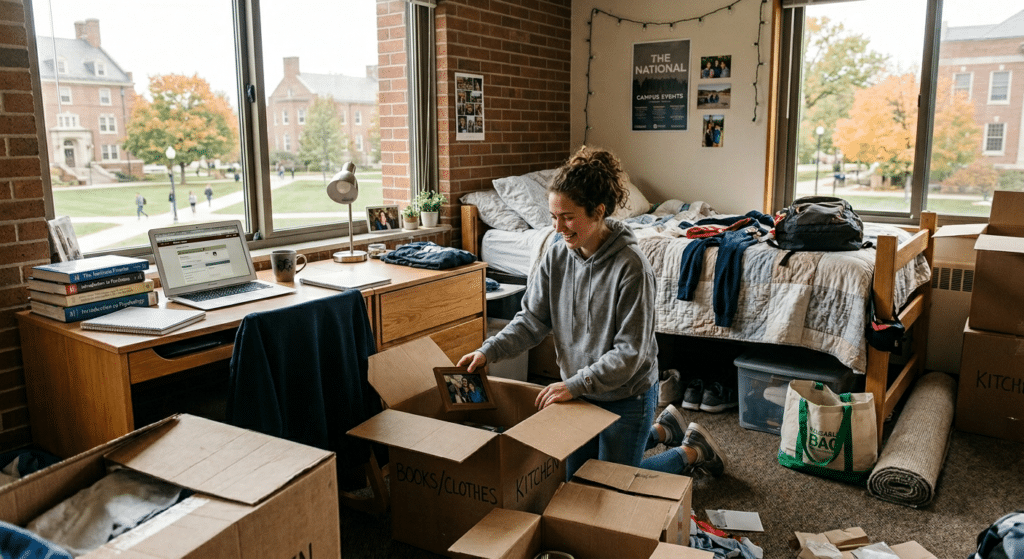
If your student lives in a college-owned dorm and still considers your home their permanent address, your homeowners insurance likely extends some protection to their belongings at school. Most standard homeowners policies treat on-campus housing as a temporary residence for a dependent, which means personal property coverage travels with the student.
The 10% Rule and Its Limits
Coverage for belongings away from home is typically capped at around 10% of your policy’s personal property limit. If your homeowners policy includes $100,000 in personal property coverage, your student’s dorm belongings may only be protected up to $10,000. For many students, that’s enough to cover a laptop, phone, and clothing. For students with more expensive electronics, musical instruments, or other high-value items, it may fall short.
Some policies also include a residency requirement. Theft claims, for example, may only be covered if the student has been living in the dorm for at least 90 days before the incident. Check your policy or call your agent to confirm the specific terms.
What a Parent’s Policy Doesn’t Cover in a Dorm
Even when coverage extends to a dorm, there are notable gaps. A parent’s homeowners policy generally does not cover additional living expenses (also called loss of use) if the dorm becomes uninhabitable due to a covered event like a fire or burst pipe. The student would need to arrange and pay for temporary housing on their own.
There may also be sub-limits on specific categories of property. Jewelry, electronics, and collectibles often have lower coverage caps than the overall personal property limit. If your student has valuable items that exceed those sub-limits, a scheduled endorsement or a separate policy may be worth considering.
When Off-Campus Housing Requires Its Own Renters Insurance Policy
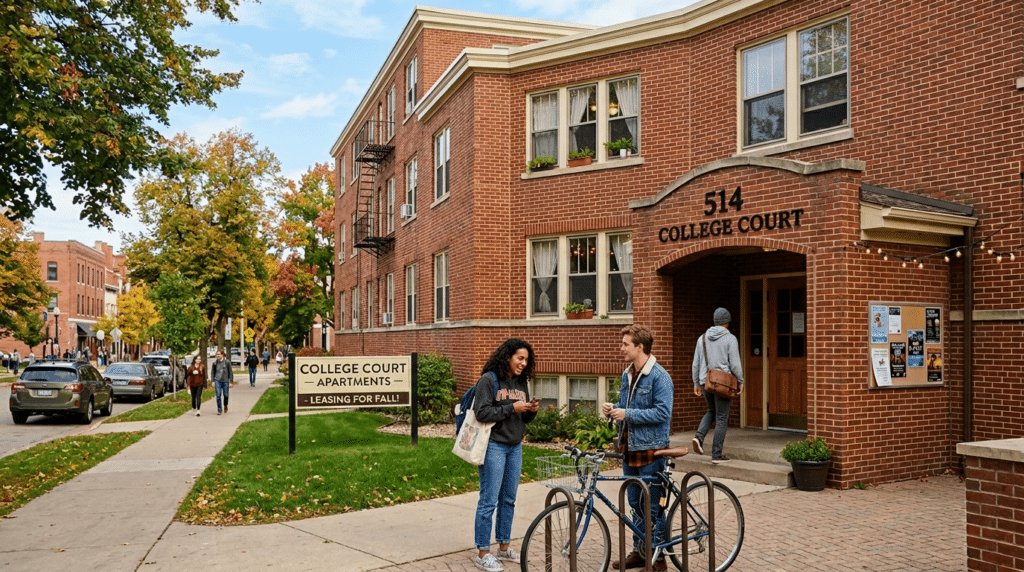
The coverage picture changes significantly when a student moves off campus. Signing a lease on an apartment or house creates a separate legal residence, and most homeowners policies stop extending coverage once the student is no longer in university-owned housing.
Signing a Lease Changes the Equation
When your student signs a lease for an apartment, a rental house, or even an off-campus fraternity or sorority house, they establish a new primary residence in the eyes of most insurance carriers. At that point, a parent’s homeowners policy typically no longer provides personal property or liability protection for the student’s living situation.
Many landlords in the Evansville area and across Indiana require proof of renters insurance as a condition of the lease. Even when it’s not required, going without coverage means the student assumes all financial risk for theft, fire damage, water damage, and liability claims.
Landlord Insurance Doesn’t Protect Tenants
A common misconception is that a landlord’s insurance covers tenants’ belongings. It doesn’t. A landlord’s policy covers the building structure, not what’s inside the tenant’s unit. If a kitchen fire destroys your student’s furniture, electronics, and clothing, the landlord’s insurance won’t reimburse a dime for those losses.
What Does a Student Renters Insurance Policy Cover?
A standard renters insurance policy provides three core types of protection. Here’s what each one means for a college student:
- Personal property coverage pays to repair or replace belongings damaged or destroyed by covered events (called perils), including fire, theft, vandalism, and certain types of water damage. This covers items inside the apartment and, in most cases, belongings away from home as well.
- Liability coverage protects the student if someone is injured in their apartment or if they accidentally damage someone else’s property. If a guest slips on a wet floor and needs medical treatment, liability coverage helps pay for those costs.
- Additional living expenses (loss of use) covers temporary housing and related costs if the rental becomes uninhabitable due to a covered loss. This is the coverage that a parent’s homeowners policy typically does not extend to a dorm or off-campus apartment.
For a deeper look at what renters insurance covers and how liability works, see our guide on renters insurance and liability.
How Much Does Renters Insurance Cost for College Students?
Renters insurance is one of the most affordable forms of personal coverage. According to the Insurance Information Institute, the national average premium for renters insurance is approximately $171 per year, or roughly $14 per month. College students who need lower coverage limits (around $10,000–$15,000 in personal property) can often find policies for even less.
Indiana’s average renters insurance costs tend to run close to or slightly below the national average, making coverage particularly accessible for students at schools like the University of Southern Indiana, the University of Evansville, and Ivy Tech. Bundling a renters policy with an existing car insurance policy can often produce additional savings. For more tips on lowering premiums, check out our post on finding affordable renters insurance.
Dorm vs. Off-Campus: A Side-by-Side Comparison
This comparison summarizes the key differences between dorm and off-campus insurance situations:
| On-Campus Dorm | Off-Campus Apartment | |
| Parent’s homeowners coverage? | Usually yes, up to ~10% of personal property limit | Typically no, once a lease is signed |
| Own renters policy needed? | Usually not, but review limits and gaps | Yes, strongly recommended or required by landlord |
| Liability protection? | May extend from parent’s policy | Requires own renters policy |
| Additional living expenses? | Generally not covered through parent’s policy | Covered under own renters policy |
| Typical monthly cost | N/A (covered under parent’s policy) | $10–$20/month for standard student coverage |
Graduate Students and Other Special Situations
Graduate students present a different insurance picture than undergraduates. Most insurers do not consider graduate students to be dependents living away from home, even if they’re in campus housing. That means a parent’s homeowners policy is unlikely to extend coverage. Graduate students should plan on carrying their own renters insurance regardless of whether they live on or off campus.
A few other situations also warrant a closer look at coverage:
- Students over 26 are often no longer eligible as dependents under a parent’s policy.
- Married students typically need their own coverage, since marriage usually removes dependent status.
- Students with roommates should each carry their own renters policy. Shared policies can create complications when filing a claim or splitting costs.
- Students studying abroad should review whether their renters policy covers belongings internationally. Many policies do, but it’s worth confirming before departure.
Steps to Get the Right Coverage for Your Student
Getting the right policy in place doesn’t take long. Here’s a practical approach:
- Review the parent’s homeowners policy. Confirm whether it extends to on-campus housing, what the coverage limit is, and whether there are residency or time requirements.
- Take a personal property inventory. List everything the student will bring to school and estimate replacement costs. Include electronics, furniture, clothing, textbooks, and anything of significant value.
- Determine if a separate renters policy is needed. If the student is living off campus, the answer is almost always yes. If they’re in a dorm, it depends on whether the parent’s policy provides adequate limits.
- Ask about bundling discounts. Many carriers offer savings when a renters policy is bundled with auto coverage.
- Consider liability limits. The cost difference between $100,000 and $300,000 in liability coverage is usually minimal. Higher limits provide a better safety net.
For a full breakdown of why renters insurance matters, our post on whether you really need renters insurance covers the fundamentals.
How Torian Insurance Helps
At Torian Insurance, we work with families across the Evansville area, Southern Indiana, Western Kentucky, and Southeastern Illinois who are navigating exactly this question every summer and fall. As an independent agency, we shop multiple carriers to find the right renters policy at the right price for your student’s specific situation.
We can also review your existing homeowners policy to confirm whether your student’s dorm belongings are already covered and identify any gaps before move-in day. If your student needs their own policy, we’ll match the coverage limits to the value of their belongings so they’re not overpaying for coverage they don’t need.
Whether your student is headed to USI, UE, Ivy Tech, or a school elsewhere in the tri-state area, we’re here to make sure their belongings and liability are protected.
Frequently Asked Questions About College Student Renters Insurance
Does my homeowners insurance cover my child’s belongings in a dorm room?
In most cases, yes. Standard homeowners policies extend personal property coverage to dependents living temporarily in on-campus housing, typically up to 10% of your policy’s personal property limit. Contact your insurance agent to verify the specific limits and any residency requirements that apply.
Do students living off campus need their own renters insurance?
Yes. Once a student signs a lease for an apartment, rental house, or off-campus fraternity or sorority, a parent’s homeowners policy usually stops providing coverage. A separate renters insurance policy is either required by the landlord or strongly recommended to protect personal property and provide liability coverage.
How much does renters insurance cost for a college student?
A standard renters policy for a college student typically costs between $10 and $20 per month, depending on coverage limits, location, and the insurance carrier. Students who need only basic coverage (around $10,000–$15,000 in personal property) are often at the lower end of that range.
Can my college student be added to my renters policy instead of getting their own?
If your student lives in a dorm and you have a homeowners or renters policy, they may already be covered as a dependent. If they live off campus, they generally need their own policy at their rental address. Adding an off-campus student to a parent’s renters policy is typically not an option because the addresses differ.
Does renters insurance cover a student’s laptop if it’s stolen from a car?
Most renters insurance policies cover personal property theft regardless of where it occurs, including from a vehicle. However, damage to the vehicle itself would fall under auto insurance. Keep in mind that filing a claim typically requires a police report.
Protect Your Student Before Move-In Day

The question isn’t really whether your college student needs protection. It’s whether the coverage they already have is enough. A quick review of your homeowners policy and a conversation about where your student will be living can clarify the answer in minutes.
If your student is moving off campus or if your current policy’s limits feel thin, a standalone renters policy fills the gap affordably. Not sure where to start? Contact Torian Insurance to talk with a local agent who can walk you through the options and help you find the right fit.